5212 stories
·
16 followers

Trump Halts Five Wind Farms Off the East Coast

1 Comment

Advertisement

SKIP ADVERTISEMENT

The Interior Department said the projects posed national security risks, without providing details. The decision imperils billions of dollars of investments.

Parts for the construction of Revolution Wind, one of five projects the Trump administration paused on Monday.Credit...Brian Snyder/Reuters

The Trump administration on Monday said it would pause leases for five wind farms under construction off the East Coast, essentially gutting the country’s nascent offshore wind industry in a sharp escalation of President Trump’s crusade against the renewable energy source.

The decision injected uncertainty into $25 billion worth of projects that were collectively expected to power more than 2.5 million homes and businesses across the Eastern United States, according to Turn Forward, an offshore wind advocacy group. The five wind farms were projected together to create about 10,000 jobs.

It left intact just two operational wind farms in U.S. coastal waters — one small project off Rhode Island that has been complete since 2016 and a larger project off New York that has been fully operational since 2023.

The five wind farms targeted on Monday had all obtained leases from the Biden administration. But citing unspecified national security concerns, the Trump administration said it would freeze those leases, effectively blocking construction or operations and jeopardizing billions of dollars that have already been invested.

One of the projects, Vineyard Wind 1 off Massachusetts, is already partially running, with about half of the project’s 62 turbines sending power to the electric grid.

But in announcing the pause, Doug Burgum, the secretary of the interior, said in a statement that “the prime duty of the United States government is to protect the American people.” He said the decision “addresses emerging national security risks as well as “vulnerabilities created by large-scale offshore wind projects with proximity near our East Coast population centers.”

Mr. Trump has repeatedly called offshore wind turbines ugly, costly and inefficient. He has disparaged the clean energy source ever since he failed 14 years ago to stop an offshore wind farm visible from of one of his golf courses in Scotland.

In addition to Vineyard Wind 1, the other projects affected by the pause are Coastal Virginia Offshore Wind off Virginia, Sunrise Wind and Empire Wind off New York, and Revolution Wind off Rhode Island and Connecticut.

The abrupt announcement left the wind farm builders sputtering.

David Schoetz, a spokesman for Equinor, the developer of Empire Wind, said the company was reviewing the stop-work order and seeking more information from the government.

Jeremy Slayton, a spokesman for Dominion Energy, called the Coastal Virginia Offshore Wind Project “essential for American national security and meeting Virginia’s dramatically growing energy needs.”

The company argued that stopping the project for any length of time would threaten grid reliability “for some of the nation’s most important war fighting, A.I. and civilian assets.”

Mr. Slayton also dismissed the administration’s unspecified national security concerns, saying the wind farm was developed “in close coordination with the military.” He also noted that the project’s two pilot turbines have been operating for five years without causing any impacts to national security.

“We stand ready to do what is necessary to get these vital electrons flowing as quickly as possible,” Mr. Slayton said.

Representatives for developers of the other projects, including the Danish energy giant Orsted, did not immediately respond to requests for comment.

The Interior Department’s description of its decision said the Pentagon had produced classified reports that found the wind farms posed national security risks and that an unclassified report from the Energy Department had found that wind farms could interfere with radar systems.

Coastal Virginia Offshore Wind had escaped attention from the Trump administration for months, in part because of strong support from Gov. Glenn Youngkin, Republican of Virginia. But its fate became uncertain after Abigail Spanberger, a moderate Democrat, won the Virginia governor’s race in November to succeed Mr. Youngkin.

In New York, Empire Wind has had an on-again, off-again relationship with the Trump administration. In April the Interior Department ordered that construction be stopped on Empire Wind, pushing the $5 billion project to the brink of collapse. After several weeks and negotiations with Gov. Kathy Hochul, a Democrat, the administration allowed the project to proceed, at least until now.

Representatives for Ms. Hochul did not immediately respond to a request for comment.

Senator Chuck Schumer, Democrat of New York, said in a statement, “Trump’s obsession with killing offshore wind projects is unhinged, irrational, and unjustified.” He said New York would “keep fighting” the administration’s stop-work orders on Empire and other offshore wind projects.

The financial consequences for the developers of the five offshore wind farms could be dire. When work on Empire Wind was initially paused in April, Equinor said it was losing $50 million a week because of idled equipment and workers.

Delays to Revolution Wind were estimated to cost its developer, Orsted, approximately $15 million per week. In October, Orsted said it would cut about 2,000 jobs, or around 25 percent of its work force, over the next two years, a decision fueled by the Trump administration’s actions as well as tariffs, high inflation and interest rates.

On the first day of his second presidential term, Mr. Trump issued a sweeping executive order halting all leasing of federal lands and waters for new wind farms. His administration has since gone after wind farms that had received permits from the Biden administration and were either under construction or about to start.

The administration’s approach has suffered some legal setbacks. A federal judge this month struck down the halt on leasing mandated by the January order, saying it was “arbitrary and capricious,” violating federal law.

Attorney General William Tong of Connecticut, a Democrat, said in a statement that the new order to pause Revolution Wind is “even more lawless and erratic” than the first.

“We went to court over this before,” Mr. Tong said, noting that a court order is in place blocking the administration’s previous attempt to stop the wind farm. “Every day this project is stalled is another day of lost work, another day of unaffordable energy costs, and other day burning fossil fuels when American-made clean energy is within reach,” he said.

Executives in the offshore wind industry called the administration’s move on Monday harmful to the U.S. economy.

“America’s offshore energy industry has put thousands of Americans to work in high-paying jobs in the construction of offshore projects that will effectively meet burgeoning demand for power throughout the northeast,” said Erik Milito, the president of the National Ocean Industries Association, which represents offshore oil drilling firms and offshore wind developers.

Retired U.S. Navy Cmdr. Kirk Lippold disputed the Trump administration’s claim that offshore wind projects threaten national security. He noted all five projects halted on Monday had undergone rigorous reviews, including by the Defense Department.

“Ironically, these projects will actually benefit our national security by diversifying America’s energy supplies, providing much-needed reliable power for the grid and helping our economy,” Mr. Lippold said.

Maxine Joselow covers climate change and the environment for The Times from Washington.

Lisa Friedman is a Times reporter who writes about how governments are addressing climate change and the effects of those policies on communities.

Related Content

Advertisement

SKIP ADVERTISEMENT

The gift that says “I get you.”
The New York Times.The New York Times.

Read the whole story
mareino
4 hours ago
reply
"National security" is literally the only excuse that the Executive Branch can give that does not subject them to the "arbitrary and capricious" standard in court. That's not a coincidence.
Washington, District of Columbia
freeAgent
2 hours ago
As I commented on a different share, with these wind turbines already built in many cases, what national security risk is mitigated by having them stand still rather than rotate? I wish the Supreme Court could rule that the current administration doesn't know the definition of National Security, and therefore cannot use that as a justification for action unless granted prior approval by the Court.
Share this story
Delete

A ‘Timeout Box’ in an Elementary School Draws Outrage: ‘This Is Not OK’

1 Comment

Advertisement

SKIP ADVERTISEMENT

An upstate New York district, where most students are Native American, placed its superintendent on leave after images of a wooden box in a classroom spread on social media.

A former school board member in upstate New York took a photo of this box in an elementary school classroom. She accused officials of building a “timeout box” for students who have disabilities, though it remains in dispute whether children were ever placed inside.Credit...Chrissy Onientatahse Jacobs

The image from the elementary school was odd: a wooden box tucked in the corner of a classroom, tall and wide enough, it seemed, for a small child or two. But the next image, of the inside, was disturbing: bare walls and a padded floor.

The photos were posted to social media this week by a former member of a school board in upstate New York. She accused officials of building a “timeout box” for students who have disabilities — though families and officials remain in dispute about whether children were ever placed inside.

It has ignited an uproar in the school system, the Salmon River Central School District, a small district with 1,300 students on the Canadian border.

Within days, the school board enlisted a law firm to investigate what happened. It reassigned the district’s superintendent to “home duties” until the review is completed. And it placed several other leaders on leave, including a principal and the district’s special education director.

Officials also revealed that the box depicted in the social media post was not the only one: Two others had been installed in schools, according to the superintendent. They have been removed.

On Saturday, Gov. Kathy Hochul said the episode “raises serious questions regarding the safety of children,” and called for the Education Department to swiftly “investigate and rectify this situation.”

“These allegations are alarming and entirely unacceptable,” Ms. Hochul said in a statement.

In a district in which more than 60 percent of students are Native American — and where schools sit alongside the St. Regis Mohawk Reservation — community members said that the episode recalled the well-documented harm and trauma that generations of Native American children faced in boarding schools.

Chrissy Onientatahse Jacobs, the former school board member who posted pictures of the box, said that the district had created an unsafe and dehumanizing learning environment for Native American children and their classmates.

“I was in shock,” Ms. Jacobs, who is a parent in the district, said in an interview on Friday. “I was shaking. Because I know a lot of people throw around the words ‘intergenerational trauma.’ But our DNA has memory.”

Image

This is the interior of the box photographed in a school that is part of the Salmon River Central School District.Credit...Chrissy Onientatahse Jacobs

The incident brought renewed attention to the enduring use of restraint and seclusion in education. The practice — which can include putting children in closets, sending them into timeout boxes and locking them in tiny rooms — has been criticized for decades.

But it sometimes remains in use in districts across the United States to manage students’ behavior, and children with disabilities and students of color are disproportionately subjected to it.

In New York State, seclusion is prohibited in public schools. State education officials ordered the upstate district to remove any remaining timeout boxes in classrooms, and said they would visit local schools to ensure there were none left.

On Friday, the school district held classes remotely “out of an abundance of caution for student and staff safety.”

The Saint Regis Mohawk Tribal Council, which presides over the reservation, said in a statement that it had lost faith in district leadership because of “gross mismanagement,” and demanded that “everyone involved in the decision to construct and install these inhumane devices” be held accountable.

“It is clear what transpired should have never happened, and our children deserve better from those in charge of their care,” the council wrote. “Trust has been broken,”

The superintendent, Stanley Harper, said in a statement on Monday that the school district permits “the use of timeout” only when students face immediate risks to their physical safety, or as part of an “intervention plan that is designed to teach and reinforce alternative appropriate behaviors.”

Mr. Harper, who did not respond to a request for comment on Friday, said in the statement that the district remains committed to providing “safe, lawful and effective educational programming” for all students, including children with disabilities.

He said that the box depicted on social media had never been used with students.

But at public meetings this week, several parents challenged that assertion, accusing the district of placing children into the timeout boxes, according to reports from multiple local media outlets including the Albany Times Union.

T.J. Hathaway, the parent of a third-grade student in the district, said in an interview on Friday that he had become emotional upon learning that the box shown in the social media photos had been in his son’s special education classroom.

Mr. Hathaway said that his son, who is mostly nonverbal, communicated that he “felt bad for one of his friends that had to go in there.”

His parents are wrestling with whether to return him to the district, or pull him out and find another school.

Mr. Hathaway said that a number of school staff members should be commended for speaking out. But he said that the district’s leadership must be overhauled.

“We need new, fresh blood in our administration that understands that this is not OK,” he said.

The school board has sought in recent days to assure families that their children are safe, with many board members saying they first learned of the boxes from social media.

The board president, Jason Brockway, apologized to the community, saying that the episode did not “reflect the values and standards of care that guide this district.”

“We recognize the pain, concern and distress these events have caused, and we are truly sorry,” Mr. Brockway said in a statement. “We understand that for many in our community this incident has reopened historical wounds and trauma connected to the mistreatment of Native Children.”

Daniel G. Stec, a state senator who represents Franklin County, which includes the school district, said that he was “appalled” by the presence of wooden boxes in classrooms, and called for a “thorough investigation and accountability.”

What took place in the Salmon River School District, Mr. Stec said, “should not have ever happened.”

Susan C. Beachy contributed research.

Troy Closson is a Times education reporter focusing on K-12 schools.

Related Content

More in New York

  • Emails obtained by The New York Times revealed that Andrew Farkas referred to himself as among Jeffrey Epstein’s best friends.

    Cindy Ord/Getty Images

  • Transit riders can tap to pay using OMNY cards, or credit and debit cards.

    Brendan McDermid/Reuters

  • There was no set number of late activations or late ticket purchases that would trigger the charge, a spokeswoman for the Metropolitan Transportation Authority said.

    Graham Dickie/The New York Times

  • Attorney General Pam Bondi recently worked for a lobbying firm that lists UnitedHealthcare’s parent company among its clients.

    Tierney L. Cross/The New York Times

  • In addition to combating fare evasion, the new type of gates are expected to make coming and going easier for riders with disabilities, as well as those with strollers or suitcases.

    Marco Postigo Storel for The New York Times

  • The end of the “stammtisch” — a weekly meeting founded in 1943 by artists exiled by the Nazis.

    Bryan Anselm for The New York Times

  • Francis Pierre Laborde in the Harlem apartment that doubles as his studio. Despite the mob scenes his bags have recently inspired, there have been long stretches of anonymous toil. “I knew people had to get to know me,” he said.

  • In less than a year, Bhavitha Mandava went from a college student who had never modeled to opening Chanel’s Métiers d’Arts show.

    Chanel

  • Syed Rahmani has been an in-room dining server at the Plaza for 27 years.

    Amanda Choy/The New York Times

  • Dóra Kisteleki

  • Ben Wiseman

  • Paula Cox renovated her house in Austin with help from the architecture firm Clayton Korte.

    Likeness Studio

  • James Ransone in 2015.

    Jeff Vespa/WireImage, via Getty

  • Police officers and a SWAT team responded on Sunday to a home in Kearny, N.J., where a person of interest in a bow-and-arrow killing was hiding.

    Dakota Santiago for The New York Times

  • Like its cousin, panettone, pandoro is a seasonal Italian favorite finding fans in the United States.

    Ye Fan for The New York Times

  • Marissa Alper for The New York Times

  • James Estrin/The New York Times

  • Seattle & King County Public Health

  • Students held a silent protest at Dhaka University in Bangladesh’s capital on Sunday to condemn the lynching of a Hindu garment worker.

    Abdul Goni/Agence France-Presse — Getty Images

Advertisement

SKIP ADVERTISEMENT

The gift that says “I get you.”
The New York Times.The New York Times.

Read the whole story
mareino
9 hours ago
reply
I am fascinated by the school insisting that it NEVER put students in any of these. So you built boxes in every classroom just to ... what?
Washington, District of Columbia
Share this story
Delete

Backing up Spotify

1 Comment and 2 Shares
We backed up Spotify (metadata and music files). It’s distributed in bulk torrents (~300TB). It’s the world’s first “preservation archive” for music which is fully open (meaning it can easily be mirrored by anyone with enough disk space), with 86 million music files, representing around 99.6% of listens.
Read the whole story
mareino
9 hours ago
reply
I love outlaw librarians
Washington, District of Columbia
freeAgent
1 day ago
reply
Los Angeles, CA
LinuxGeek
1 day ago
Can't imagine having time to listen to and appreciate 300 TB of music. Radio stations repeat the same songs every day. I read somewhere that many people are happy listening to the same music that was popular in their teens and twenties.
Share this story
Delete

https://screenshotsofdespair.tumblr.com/post/803631172513087488

1 Share
Read the whole story
mareino
9 hours ago
reply
Washington, District of Columbia
Share this story
Delete

Streaming music is the lie we tell each other

1 Comment and 2 Shares

Stephanie Vee: Delete Spotify? Sure, But Don't Just Replace it With Another Subscription

streaming music sucks for almost everyone involved. I believe we only do it because we’ve allowed ourselves to be convinced that renting music indefinitely is cheaper than purchasing it outright – especially since streaming companies grant us the equivalent of an all-you-can-eat buffet with our subscriptions.

Spoilers for an upcoming Cozy Zone episode, but I've come to the conclusion that streaming music platforms are a shared lie we all agree to that suggests we're paying for music when we're actually may as well be pirating it, we just pay $10 a month to keep the cops away.

To me, a music streaming subscription only really makes sense if you’re at that impressionable stage of your life where you still live and breathe new music – or if you’re one of those rare people who continue to seek out new music as you age. As for the rest of us? I think we should maybe just own our shit and stop paying tech CEOs to rent it. Chances are, I’ll still be rocking out to Hot Fuss in my retirement home, so why should I rent it from the likes of Daniel Ek for the next four decades (or longer)?

As one of the seemingly rare 40-year-olds who still checks the new music releases every week, this resonates with me as well. I kind of feel like I want to buy all of the music I listen to in 2026…we'll see.

Read the whole story
freeAgent
3 days ago
reply
I, for one, never bought into this lie. I own all my music, always have, and it's great.
Los Angeles, CA
mareino
2 days ago
reply
Washington, District of Columbia
Share this story
Delete

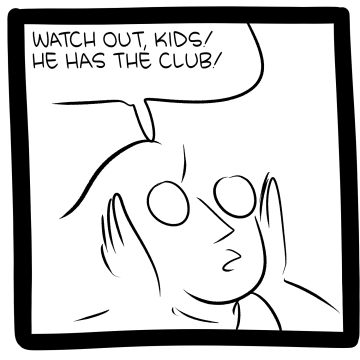
Saturday Morning Breakfast Cereal - Where

1 Share


Click here to go see the bonus panel!

Hovertext:
We could build this NOW. The future of damaging children is HERE.


Today's News:


Red Button mashing provided by SMBC RSS Plus. If you consume this comic through RSS, you may want to support Zach's Patreon for like a $1 or something at least especially since this is scraping the site deeper than provided.
Read the whole story
mareino
3 days ago
reply
Washington, District of Columbia
Share this story
Delete
Next Page of Stories