Unfortunately, I have another thing for you to worry about.
There are three types of environmental harm. The first kind is local — think air pollution and water pollution. This kind of activity hurts people who are geographically close by — when factories dump crap in the water, it’s local communities who get cancer, and so on. This kind of local pollution is typically solved by a local or national government, using things like regulation, pollution markets, and so on.
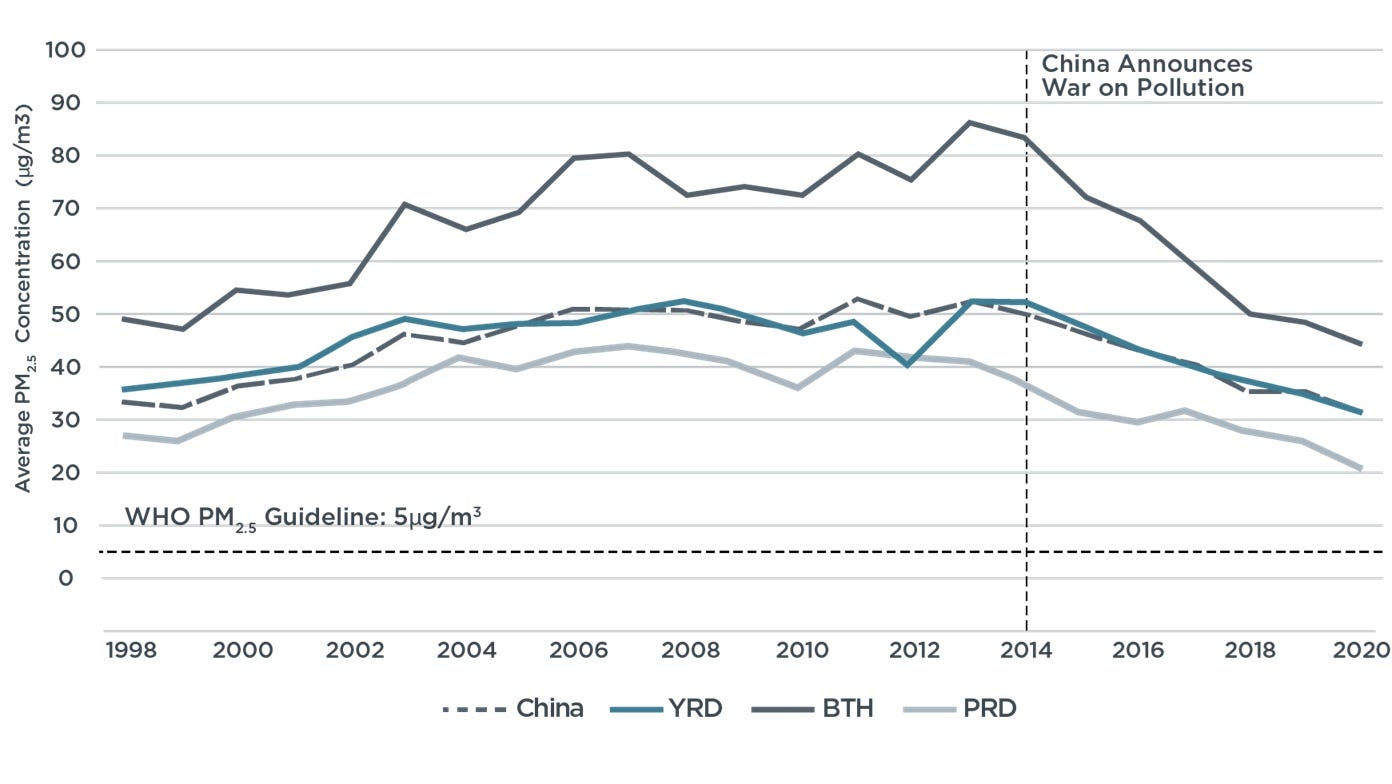
In fact, humanity has a pretty good track record when it comes to problems like this. The Environmental Kuznets Curve — the theory that countries pollute less as they get richer — seems to hold true for air and water pollution. As people escape poverty, they demand a cleaner local environment. For example, China used to be known for its toxic, unbreathable air, but in the 2010s it launched a successful cleanup policy:
The second kind of environmental harm — global harm — is a lot harder to deal with. These are things that mostly hurt people in other countries — global warming being the primary example. It’s very hard to solve global warming, because the worldwide nature of the harm means there’s a free rider problem (or, if you prefer, a coordination problem) — no country wants to pay the full cost of decarbonization, because most of the benefit goes to people in other countries. You can try international agreements, but everyone has an incentive to cheat.
Often, the best solution to these problems is technological — you simply invent something better and cheaper that doesn’t pollute as much, and then every country has an incentive to switch. Essentially, you use the positive externality of technology to fight the negative externality of pollution. This is what we did with HFC refrigerants, which replaced the CFCs that were destroying the ozone layer. It’s how we’re now fighting climate change with solar, batteries, and other green energy technologies.
But there’s a third kind of environmental harm, which is harm to the natural world. When pollution or logging or mining destroys natural habitats, it often doesn’t cause much harm to human beings — at least, not to those who are alive today. When coral reefs get bleached and die from industrial runoff, it might hurt tourism revenue a tiny bit, but overall humans don’t really get hurt. Animals and plants get hurt, but they have no voice in human politics. Future generations might regret not having coral reefs around, but they don’t exist yet, so they can’t complain.
Solving these harms seems like it probably requires some degree of altruism — either people caring about conservation for its own sake, or people who care a great deal about leaving a healthy natural world for their unborn descendants.
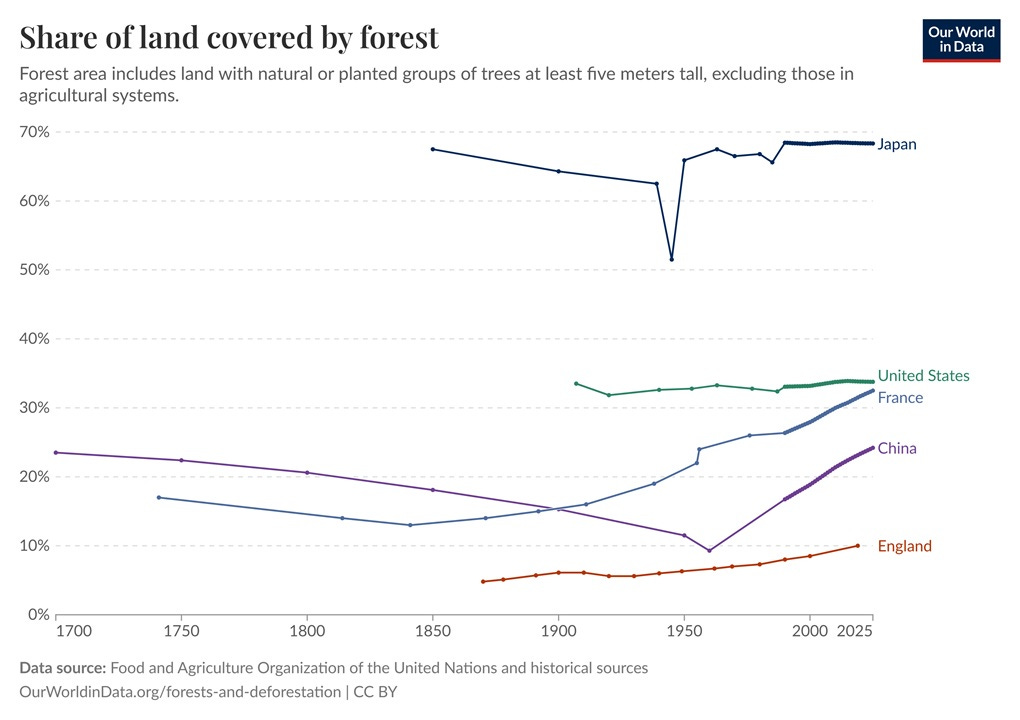
Altruism sounds like it won’t go far when matched against brute economic self-interest. But in recent years, I’ve become more optimistic that humans will care more intrinsically about preserving the natural world as they get richer. For example, people in North America, Europe, and East Asia all seem to care a lot about having forests:
This suggests that we won’t see a “race to the bottom” in terms of biodiversity loss, because the most powerful countries don’t seem to be the ones that chop down all their forests. Even Brazil, the worst offender in terms of sheer amount of forest cut down, has decreased the rate of Amazon deforestation by quite a lot since the early 2000s.
And that in turn hints at an even more important idea — that societies don’t trend toward greater rapaciousness as they become richer and more powerful. In his book The Better Angels of Our Nature, Steve Pinker theorized that people become more altruistic as they become more comfortable and secure; increasing global commitment to biodiversity seems to fit that theory. That might even be good news for the future of superintelligent AI — if rich nations stopped chopping down their forests, then maybe AI won’t kill the human race to use our resources for data centers.
Encouragingly, note the progress in China on the chart above. Some of this reforestation is motivated by the self-interested need to stop soil erosion and desertification, but China’s government has also increased its commitment to biodiversity. As another example of this, China banned fishing in the Yangtze River in 2021, in order to save fish stocks.
But there appear to be limits to China’s altruism here. Even as it took measures to prevent overfishing within its borders, China has continued to overfish much of the world’s oceans.
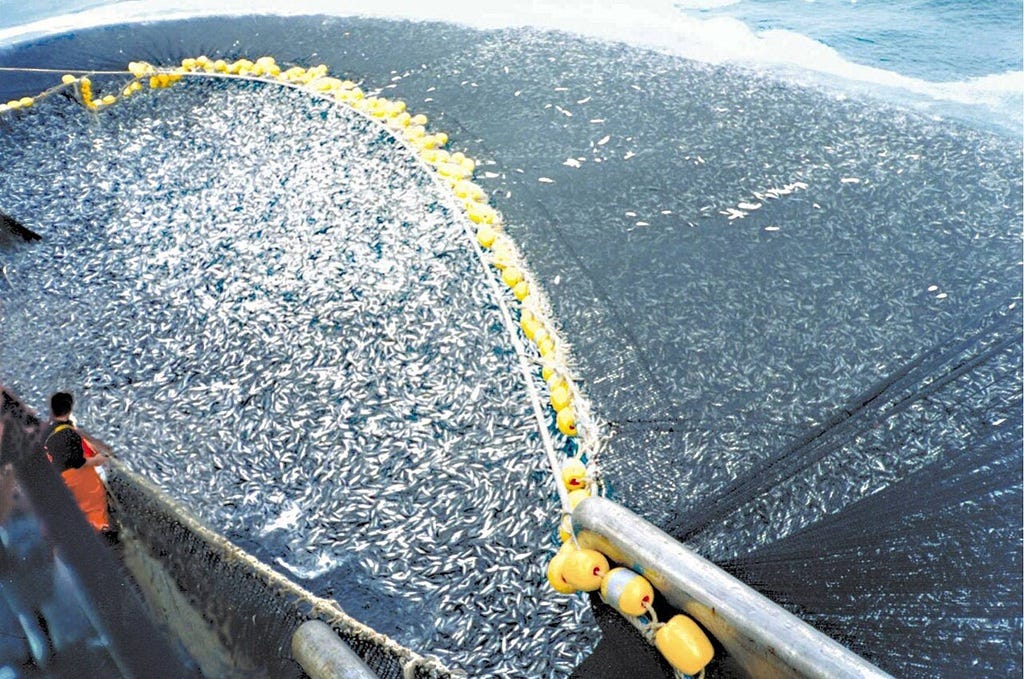
China’s fishing fleet just keeps getting bigger and bigger. This is from a 2025 report from the environmental group Oceana:
Oceana released an analysis of China’s global fishing* activity worldwide between 2022 and 2024. The analysis shows China’s global fishing footprint, in which 57,000 of their industrial fishing vessels dominated 44% of the world’s visible fishing activity during this period…Chinese vessels accounted for 30% of all fishing activity on the high seas, appearing to fish for more than 8.3 million hours.
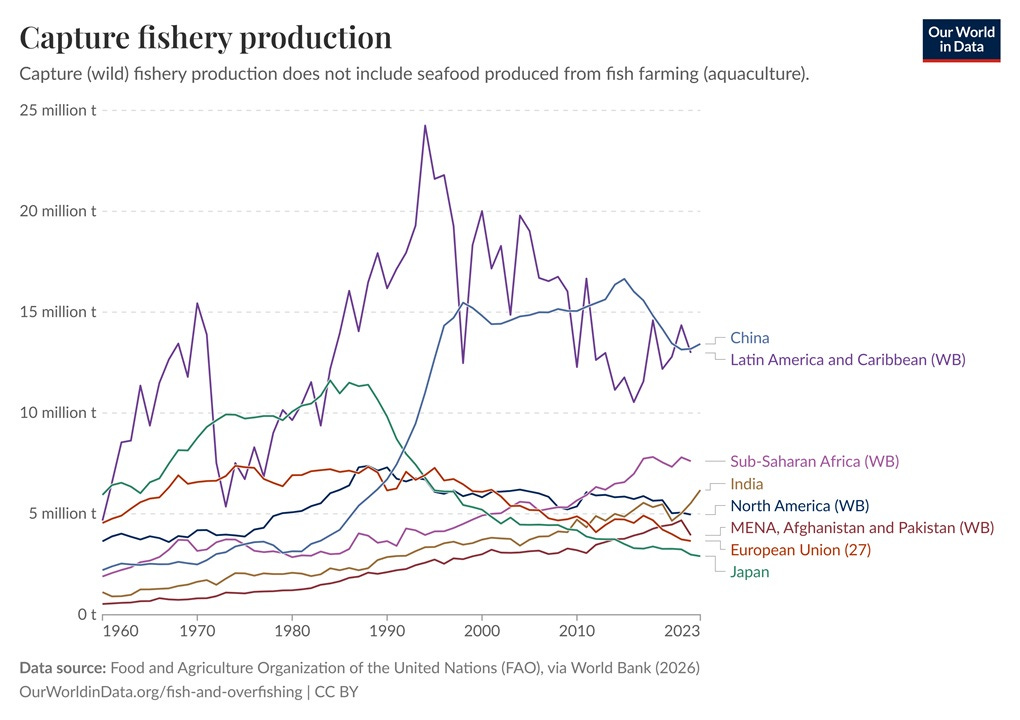
In terms of catching wild fish, it’s basically China and Latin America dominating everyone else:
Much of this fishing activity is either outright illegal — meaning Chinese vessels fish in other countries’ waters in violation of their local laws or regional agreements — or unreported. In addition to simply violating laws with impunity, Chinese fleets use a large variety of tricks to get around regulations meant to keep them from overfishing — turning off their transponders, falsifying records, using foreign front companies, and so on. A lot of this fishing activity isn’t just to fuel China’s own increasing fish consumption — it’s an export industry. Here’s a detailed report from the Outlaw Ocean Project. Some key excerpts:
The size and behavior of the Chinese fishing fleet raises concerns…The Chinese government and western seafood companies often dismiss illegality in the fishing industry as an isolated problem. But [our] investigation revealed a wide pattern: Almost half of the Chinese squid fleet, 357 of the 751 ships studied, were tied to human-rights or environmental violations…
More than 100 Chinese squid ships were found to have fished illegally, including by targeting protected species, operating without a license, and dumping excess fish into the sea. The investigation revealed other environmental or fishing-specific crimes and risk indicators, including Chinese ships illegally entering the waters of other countries, disabling locational transponders in violation of Chinese law…transmitting dual identities (or “spoofing”)…fishing without a license, and using prohibited fishing gear. But the most common environmental violation involved Chinese ships poaching fish from other countries’ waters…
About 80 percent of seafood consumed in the U.S. is caught or processed abroad, with China as its biggest supplier.
Poor countries in Latin America and Africa don’t have the state capacity or economic leverage to enforce their laws. As a result, their waters are crammed with vast fleets of Chinese fishing boats:
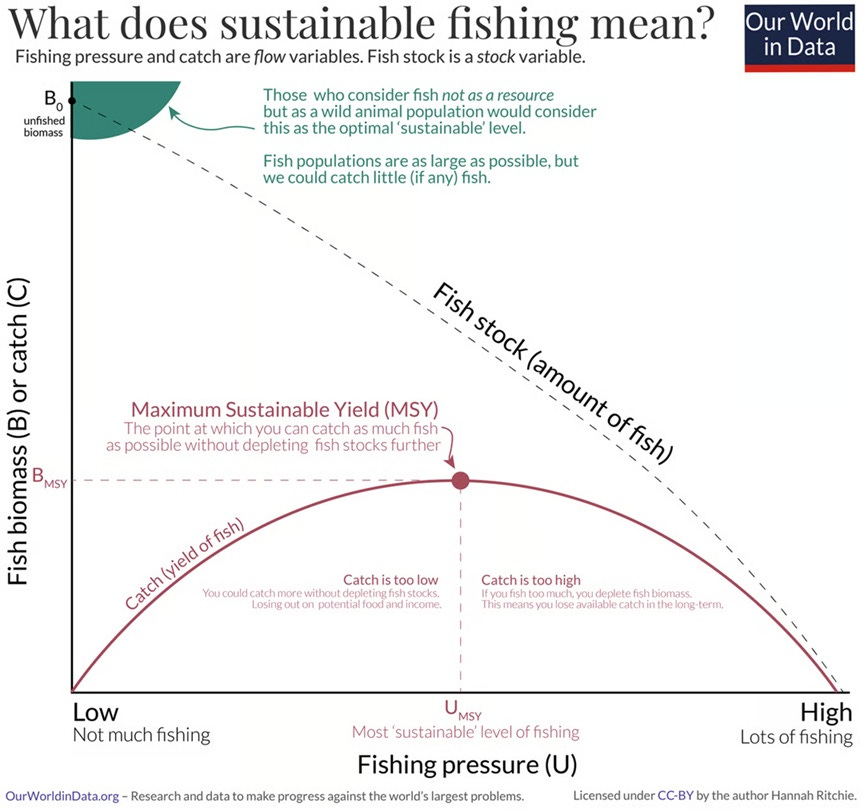
Why is Chinese overfishing bad? Obviously it hurts fishermen in poor countries by taking away their fish. But in addition, it hurts biodiversity and robs future generations of fish. Here’s a good primer from Our World in Data that shows what you would do if you cared mainly about biodiversity, versus what you would do if you cared mainly about sustainability:
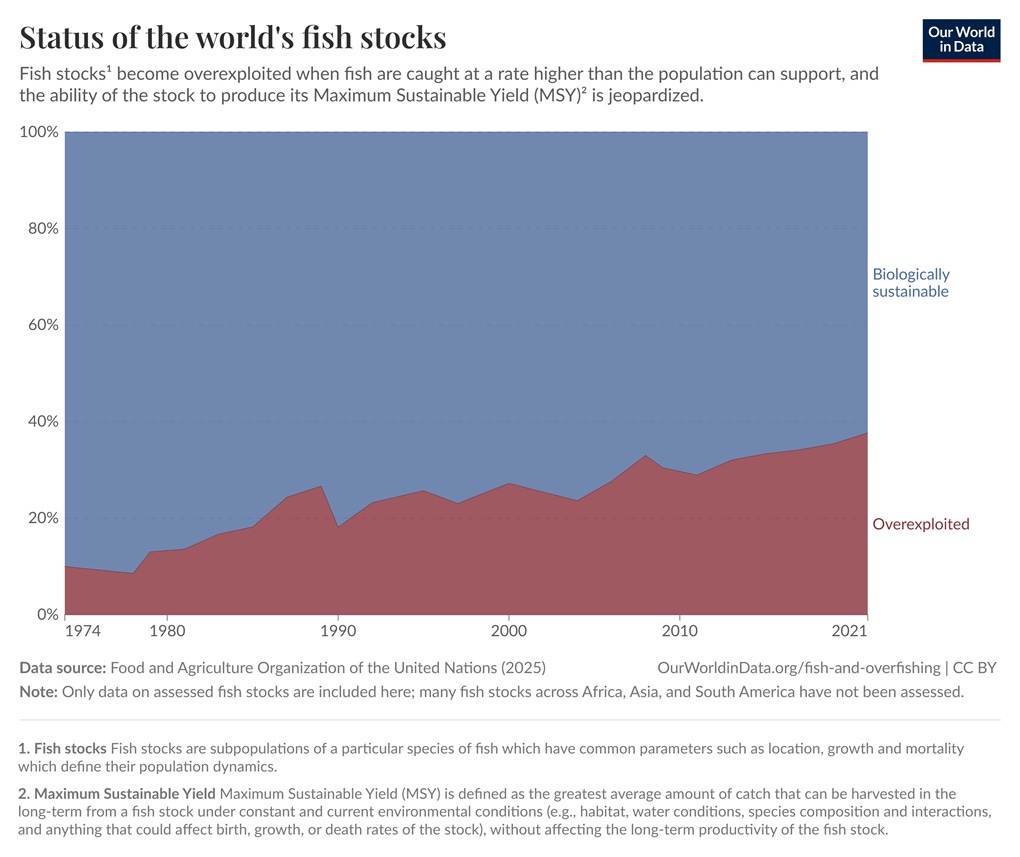
The key fact here is that whether you care more about the natural world or whether you care more about future humans being able to eat fish, the world is catching too many fish. An increasing percent of the world’s fisheries are now overexploited:
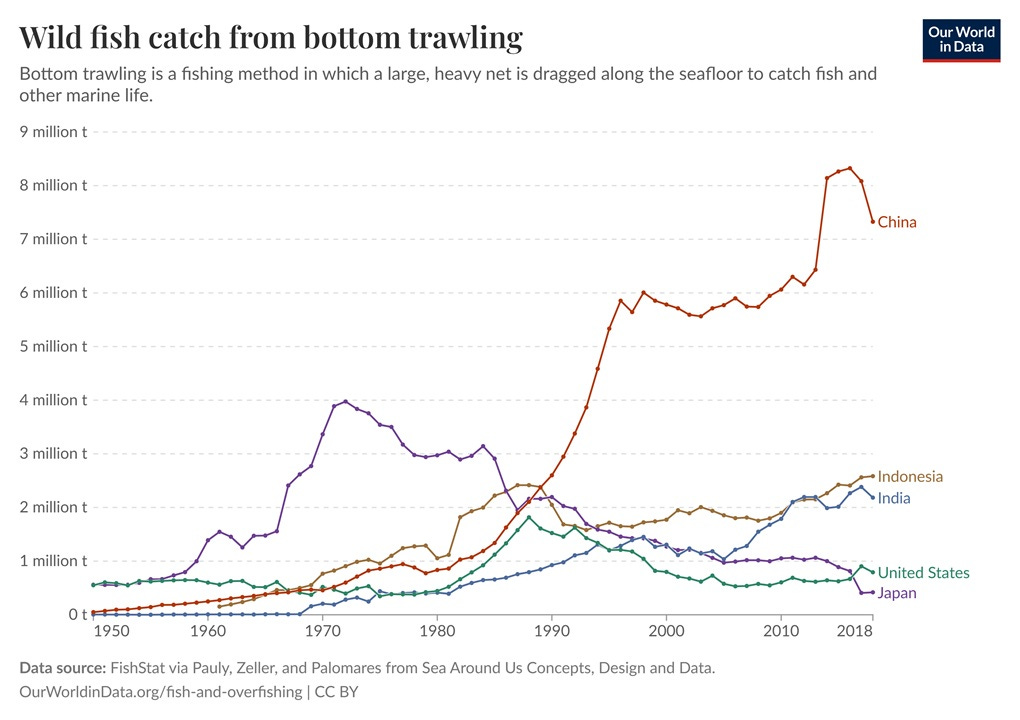
China’s lack of concern for sustainability plays a large part in this. Chinese fishing vessels are more likely to use various techniques that make them catch more juvenile fish. One of these is bottom-trawling, which drags nets along the seabed. Japan and the U.S. have largely given up on this practice; China has long been the world’s worst offender.
In previous decades, environmental organizations like Greenpeace sounded the alarm over Chinese overfishing. In recent years, with a few commendable exceptions like Sea Shepherd, they have mostly gone quiet. This is unfortunately consistent with the idea that legacy environmental groups are generally drifting from universal values of environmental protection toward a more explicitly leftist stance that focuses exclusively on critiquing the West and ignores environmental abuses by non-Western countries. (You can also see this in climate groups’ stubborn refusal to criticize China, which is by far the world’s worst climate polluter.)
In other words, geopolitics is starting to intrude into environmental debates. Most of the alarms now being sounded about Chinese overfishing come from “China hawks” rather than from environmentalists. And geopolitics is probably a big part of the reason China hasn’t cracked down on its global overfishing practices.
Traditionally, a lot of China’s overfishing has been due to massive subsidies that the Chinese government gives to the industry, mostly in the form of cheap fuel and other support. In the late 2010s, China began curbing those subsidies a bit. But as Ian Urbina reported back in 2020, these efforts have been pretty slow and minor when it comes to international waters, and geopolitics is probably a big reason:
[M]ore than seafood is at stake in the present size and ambition of China’s fishing fleet. Against the backdrop of China’s larger geo-political aspirations, the country’s commercial fishermen often serve as de-facto paramilitary personnel whose activities the Chinese government can frame as private actions. Under a civilian guise, this ostensibly private armada helps assert territorial domination, especially pushing back fishermen or governments that challenge China’s sovereignty claims that encompass nearly all of the South China Sea.
“What China is doing is putting both hands behind its back and using its big belly to push you out, to dare you to hit first,” said Huang Jing, former director of the Center on Asia and Globalization at the Lee Kuan Yew School of Public Policy in Singapore.
Chinese fishing boats are notoriously aggressive and often shadowed, even on the high seas or in other countries’ national waters, by armed Chinese Coast Guard vessels…From the waters of North Korea to Mexico to Indonesia, incursions by Chinese fishing ships are becoming more frequent, brazen and aggressive.
In other words, China’s government is becoming increasingly concerned about biodiversity and sustainability for its own sake, and this has resulted in more sustainable fishing practices in China’s own waters. But at the same time, China is using its vast international fishing fleet as a sort of naval militia to press its claims on other countries’ waters. And this is having collateral damage on the natural world — China’s quasi-military subsidies for its fishing fleet are resulting in too much actual fishing taking place.
In one sense, this is actually kind of optimistic. The fact that China is overfishing international waters for military and geopolitical reasons, rather than out of pure economic rapacity, suggests that the Chinese are not an exception to the rule that richer societies start to care more about sustainability — and, perhaps, about the intrinsic value of the natural world as well.
But in the meantime, the bad news is that China’s decision to maintain its fishing fleet as a naval militia means that the world’s oceans are being despoiled and drained of wildlife. That’s not good, and I wish that more environmentalists would pay attention to the problem. As power and wealth shift away from the West, the environmental movement risks making itself irrelevant if it continues its recent practice of letting countries like China off the hook.
Subscribe now
Share
 Log in










 reply
reply


