
5452 stories
·
17 followers

Everyone is Made of Glass

1 Share

Post image for Everyone is Made of Glass

I always liked stories about eccentric royals doing mad things.

Queen Christina of Sweden reportedly had a miniature cannon made for firing tiny cannonballs at fleas in her bedroom. Louis XIV made a proto-reality-show of his daily routines, allowing an audience of courtiers the honor of watching him dress, bathe, and use the toilet.

Peter the Great famously returned from a tour of Western Europe, and refused to let men have beards near him. Intent on “modernizing” Russia, he personally shaved many of his noblemen, and implemented a beard tax.

The weird behaviors of aristocrats always seemed especially fanciful to me. We probably only know about their quirks because they had the power to make others take them seriously.

When a famous person expresses a novel form of madness, it sometimes catches on. In the 1390s, Charles VI of France came to believe he was physically made of glass. Insisting he could be easily shattered, he wouldn’t let people touch him, and had iron reinforcing rods sewn into his clothes.

In the centuries that followed, this same odd delusion reappeared several times, all in members of the educated classes. From Fear and Fragility: The Glass Delusion and its History by Tamara Sanderson:

The physicians André Du Laurens and Alfonso Ponce de Santa Cruz independently documented a nobleman who believed himself to be shaped specifically like a glass pitcher. Not merely made of glass, but also contained by it: he slept buried in straw, terrified that he might tip in the night and pour himself out across the floor.

[…]

The Dutch physician Levinus Lemnius, writing in the mid-sixteenth century, treated a patient who was rational and highly functional in every respect save one: the absolute conviction that his buttocks were formed from the same stuff as windowpanes.

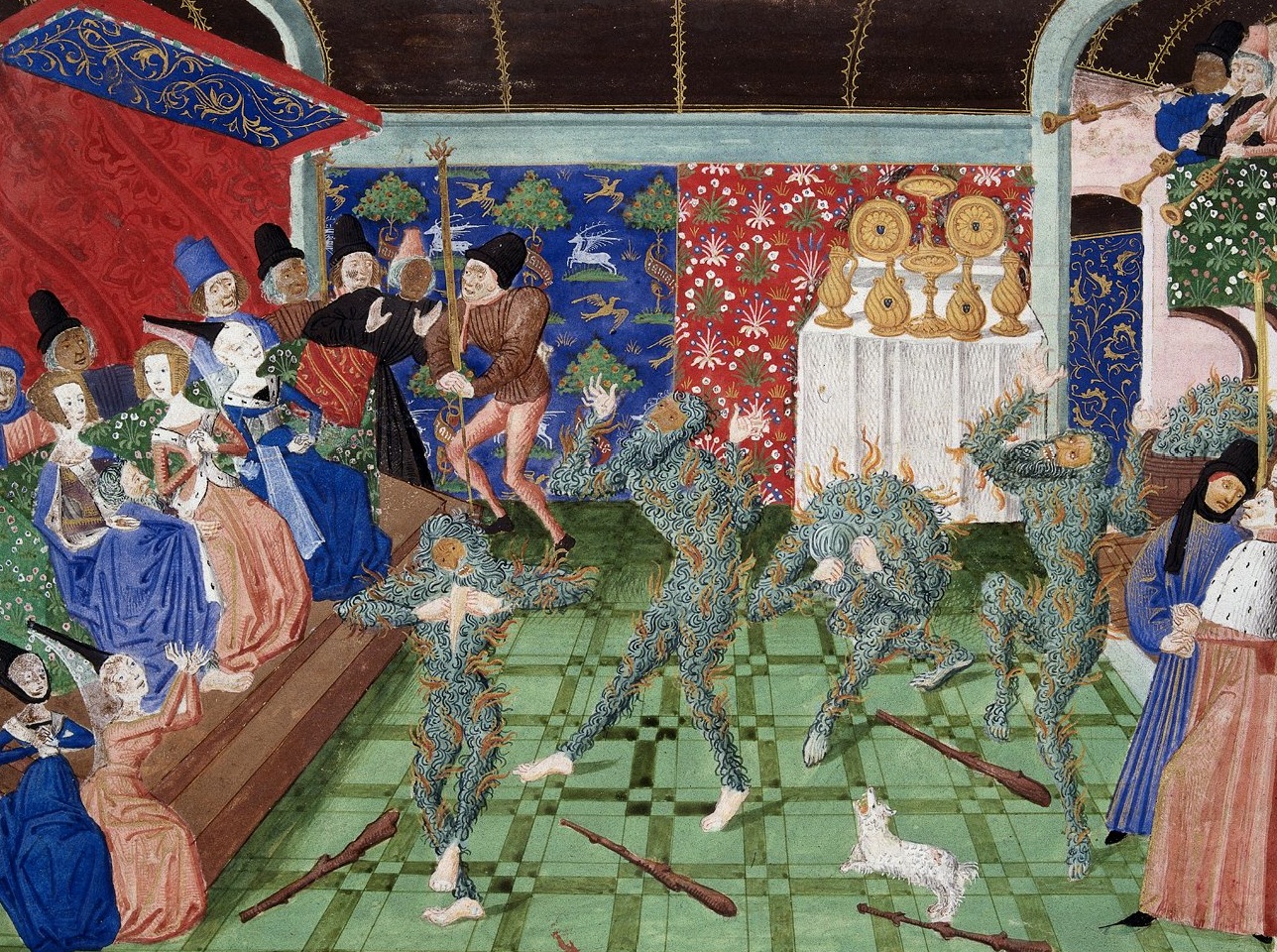
My first reaction was that this was all very funny, especially the illustrations. There’s something about art depicting European nobles, with their tights, decadent hats, and throngs of attendants, that makes it hard to take their distress seriously.
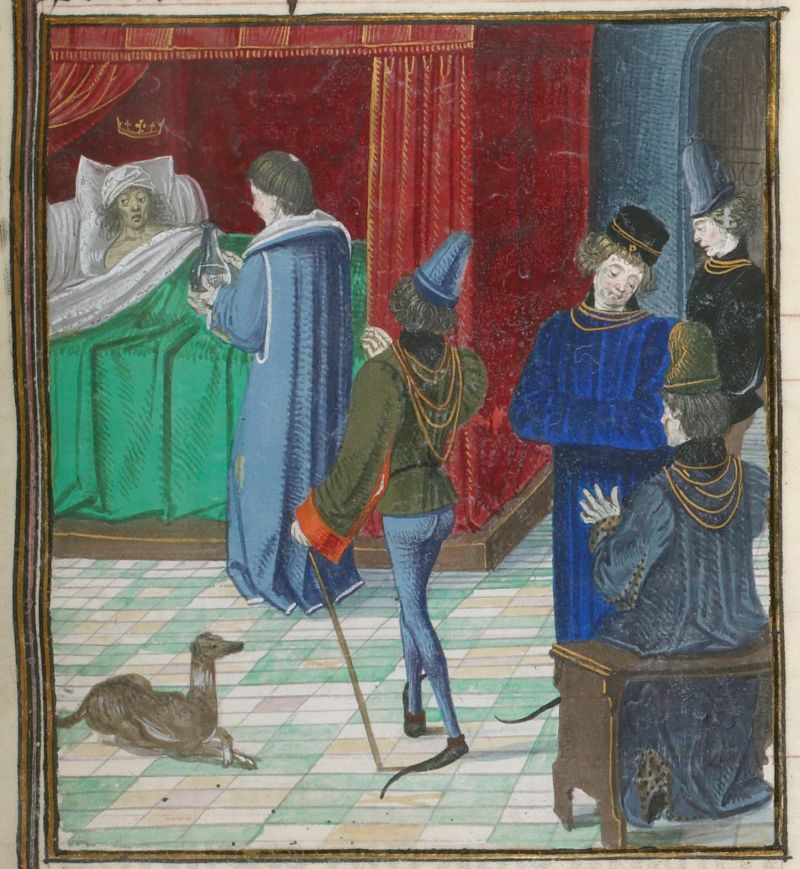
Charles VI, feeling fragile
The tragic “Bal des Ardents”

When I read about what was happening in the second painting, my attitude changed. It depicts a masquerade party gone horribly wrong.

King Charles and five dancers had dressed up as “shaggy forest creatures,” wearing linen suits coated in pitch and feathered with flax. The king’s brother Louis, drunk and arriving mid-dance, tried to inspect one of the dancers with a torch, and the costumes went up one after another.

The king was the only one who didn’t catch fire. His quick-thinking aunt hid him under the billows of her skirt. One dancer saved himself by leaping into a vat of wine, and the other four died of their terrible burns.

It was only a few weeks after this incident that Charles ordered his attendant to sew iron rods into his clothes.

Charles, saved, for the moment

The previous summer, he’d been involved in another tragic incident. While the king was riding with some of his men, a commoner ran up to him and warned him he was about to be betrayed. A man-at-arms dropped his sword at that moment, and the king spun and killed him. He charged at his other men, presumably thinking they were assassins, killing four of them before being dragged from his horse.

Charles was catatonic with despair for days following the incident, and slowly improved over the autumn. The masquerade party, in January, was meant to cheer him up.

Reading about all this made me feel embarrassed. I had always seen the royal-class people in those paintings as out-of-touch fools at best. One of them going mad and thinking he’s a turkey or a glass decanter fit this prejudice perfectly. I didn’t quite see them as people with minds and hearts like mine. By title Charles was a powerful king, but he was also an overwhelmed young man, lying in bed, wracked with guilt, afraid someone might bump him and shatter him for good.

Not about to let the fleas win

It’s easy to dismiss someone’s anxiety when you think they’re delusional. Of course you’re not a glass pitcher who might spill everywhere. Why don’t you worry about real problems? A guy at work is distraught because the FBI is monitoring him through old TV antennas. A college student is certain the communist revolution will free the world from oppression, and she’s terrified it won’t come soon enough.

Everyone lives in their own mental world, and each of us is certain of things that others can see are delusions. But we’re all completely entangled in our stories, and even if the facts are wrong, the anxiety each person feels is as real as the floor beneath them. We know how vulnerable we are, and how easily things go wrong, so we fixate on any story that feels like a path to safety.

Let’s take a different street

When you regard someone as having the wrong beliefs, contempt comes easily, even ill will. How could they think that?! But I think it’s worth focusing on the reality of their anxiety instead, because that’s the real common ground.

That line of thinking often occurs to me when I’m stuck in traffic. Everybody wants to move, nobody can, and it always seems like someone else’s fault. Over the years I developed two tricks for managing your impatience with other drivers. When you notice you’re getting indignant, you can do one or the other or both.

The first one is to imagine that the person in the offending car is your aunt. She might turn too wide, signal late, or be slow to react to the green light. She’s not the best driver, no. But she doesn’t deserve your contempt.

Just trying to get home

The second one is similar but broader. You picture all the cars around you as being driven by creatures that are as breakable as fine china. Even though everyone is zipping around in these high-tech machines, the drivers inside are all very delicate. Just like you, even a mean word could wound them for a long time. No matter what people believe, everyone is made of glass.

***

Read the whole story
mareino
30 minutes ago
reply
Washington, District of Columbia
Share this story
Delete

internalising this a lot these days

1 Comment and 2 Shares

loveridden1999:

internalising this a lot these days

Read the whole story
hannahdraper
15 hours ago
reply
Legit how I survive being a relatively awkward person fulfilling a relatively mid-senior management position.
Washington, DC
mareino
3 hours ago
reply
Washington, District of Columbia
Share this story
Delete

https://screenshotsofdespair.tumblr.com/post/831670710961340416

1 Share
Read the whole story
mareino
8 hours ago
reply
Washington, District of Columbia
Share this story
Delete

Victory! Court Rules OPM Data Disclosure to DOGE Is Unlawful | Electronic Frontier Foundation

2 Shares

In a victory for data privacy, a federal court in New York definitively ruled that the Office of Personnel Management (OPM) violated the law when it disclosed millions of federal employee records to DOGE agents. In a summary judgment ruling issued on October 20, 2026, the court found that OPM violated two provisions of the Privacy Act—one restricting disclosure of personal records between agencies and another requiring agencies to protect the security and confidentiality of records.

Since the case was filed, many DOGE agents have left the government and OPM has rescinded their database access. However, OPM should still clean up the cybersecurity mess it created. The court will decide the remedy at a later date.

"By virtue of the Court’s summary judgment ruling, OPM’s decision to grant DOGE Agents broad access to its systems of recordings containing [personally identifiable information (PII)] has been held unlawful," Judge Denise Cote wrote.

"The record also provides no support for a finding that it was the pursuit of a modernization agenda that prompted OPM to grant sweeping and expedited access to a score of DOGE Agents to its systems of records containing PII," she added.

OPM maintains databases of highly sensitive personal information about tens of millions of federal employees, retirees, and job applicants. Starting in January 2025, OPM disclosed data to the U.S. DOGE Service, initially led by Elon Musk. This disclosure violates the federal Privacy Act of 1974, a watershed anti-surveillance statute that prevents the federal government from abusing our personal information.

EFF sued OPM and DOGE because this data disclosure violates the Privacy Act. We represent unions of federal employees – the American Federation of Government Employees and the Association of Administrative Law Judges – and individual employees. We seek injunctive and declaratory relief. We filed in the U.S. District Court for the Southern District of New York.

Our co-counsel are Lex Lumina LLP, State Democracy Defenders Fund, and The Chandra Law Firm LLC.

Donate to EFF

Support Privacy & Government Accountability

Read the whole story
mareino
8 hours ago
reply
Washington, District of Columbia
acdha
5 days ago
reply
Washington, DC
Share this story
Delete

I agree to your terms.

1 Share

blogofex:

iteratedextras:

balioc:

One of the most common libertarian-adjacent anti-government arguments - or, uh, argument-like gestures (non-derogatory) - is: Boy, the DMV sure does suck! Or, if you prefer, Reagan’s old line about hearing that someone is from the government and here to help. The government is bad at doing things, its works are expensive and inefficient, everything it touches turns to shit. Sensible people will want to avoid engaging with it, and avoid sinking resources into it, as much as possible.

And there are obviously elements of truth to this, if you’re discoursing in good faith, although it’s just as obvious that the government regularly works miracles that go unappreciated because they get immediately folded into the status quo.

There has been a lot of talk, of late, about the growing popularity of socialism, and the way that all the kids treat “capitalism” as a dirty word, and the general contempt for private enterprise, etc. etc. Much of that talk has come from people who regard this as very bad and want to put a stop to it.

I respectfully submit: a large part of what’s going on is, well, enshittification. It’s increasingly noticeable that all the businesses with whom you interact are focused on extracting money from you in exchange for as little as possible. Quality sucks across the board. Customer service sucks. Shrinkflation, planned obsolescence, etc. etc.

Sensible people will want to avoid engaging with that, and avoid sinking resources into it, as much as possible!

And, yes, it’s true that business has also repeatedly given us marvelous miracles in recent years, and that those miracles go unappreciated because they get immediately folded into the status quo. But stomping your feet, and insisting that you don’t get enough appreciation for all that you do, is not a winning strategy in the arena of public opinion.

People who want to rehabilitate capitalism really might want to think about doing what it takes to fix the current culture of business.

“Reduction of consumer surplus,” in econ terms.

So here’s the plan: every company is either a startup or a chaebol. If you’re a startup you get to move fast and break things, invent new products, innovate your processes, remove your processes, create new products, deprecate old ones, lower prices, raise prices, eliminate the entire concept of prices, etc. Your shareholders will probably lose everything and your company will go bankrupt, but there’s a small chance that you all become billionaires.

If you’re a chaebol then you are part of a government-enforced oligopoly and everything you do involves infinite bureaucracy and is guaranteed to be basically the same forever. You cannot change your prices without an act of Congress, you cannot mothball old products, you cannot substantially change the products you already offer without signoff from 57 government regulators. You will not maximize shareholder value. You will not delight your customers. You will also not annoy them by enshittifying a product that they’re used to. You will provide modest, mostly-predictable returns to your customers and a well-understood palette of the same products at the same quality for ever and ever.

Occasionally a startup will become very successful. At some well-defined revenue threshold (somewhere around $10B), you are legally required to stop being a startup and become a chaebol instead, with all of the implications listed above. Everyone understands this, and when you cross the threshold you will have an official ceremony with the head of the SEC, shake hands with your new regulatory best buddies, and be invited into the secret group chat with all of the other chaebol oligarchs. Everyone in the business will understand that the exciting times are over and everything from here on out is following procedures and obeying regulations, and the customers will understand that whatever the product is now is what it will be for the rest of time.

I agree to your terms.

Read the whole story
mareino
3 days ago
reply
Washington, District of Columbia
Share this story
Delete

Yeah, but some don’t.

1 Share

Read the whole story
mareino
3 days ago
reply
Washington, District of Columbia
Share this story
Delete
Next Page of Stories