
5463 stories
·
17 followers

D.C. is poised to pass major utility reforms. Will they get gas and electric bills under control?

1 Share
D.C. is poised to pass major utility reforms. Will they get gas and electric bills under control?

Soaring gas and electric bills electrified the city’s elections and jumpstarted a debate about how policymakers can address a huge piece of the District’s affordability crisis. After months of debate, the D.C. Council has its answer, advancing its most sweeping suite of utility reforms in years.

Pepco and Washington Gas are used to getting their way in the Wilson Building — the utilities count a host of former councilmembers and staffers as part of their high-dollar lobbying operations — so the GRID Act is unusual for how directly it challenges their power. It sets the stage for regulators to limit the size of their yearly profits in order to disincentivize them from raising rates or launching costly infrastructure projects, as well as imposing stricter regulations on third-party suppliers, making changes to the utilities commission, and a number of other reforms.

Written by Ward 6 Councilmember Charles Allen and co-introduced by six of his colleagues, the bill passed on a first vote last week and is expected to take a second one in December. But there are real questions about whether, and how quickly, the reforms can deliver relief for residents. 

“They’re putting these huge data center warehouses out in the suburbs and it’s causing everyone's prices to go up, whether you're in Maryland, D.C., or Virginia,” said former councilmember David Grosso, who’s been lobbying against some of the GRID Act’s provisions on behalf of third-party suppliers. “And I don't think that this is going to solve that problem.”

Even some of the bill’s proponents believe it’s far from sufficient to address the scale of the problem, acknowledging that the city can’t unilaterally resolve prices driven up by the war in Iran and construction of data centers. And the provisions won’t take effect in time to stop rate increases immediately, particularly with more on the way in the coming months. But they don’t see that as a reason for the city to sit on its hands. 

Many of the changes have been on environmentalists’ wishlists for years, particularly those aimed at overhauling the District’s Public Service Commission, which regulates Pepco and Washington Gas. 

“We have had terrible oversight from the Council for a decade, we have had terrible regulation from the Public Service Commission for a decade or more, and the result has been skyrocketing electricity and gas prices,” says Mark Rodeffer, political committee chair for the D.C. Sierra Club. “It really is time to rein the utilities in.”

Naturally, this has attracted pushback from the utilities, which have been urging councilmembers to amend the bill before it passes, particularly the piece that could impact profits. It’s unlikely they’ll convince the Council to reject the legislation entirely — it passed unanimously — but the next few weeks before a final vote will likely be full of debates that could reshape some of its key provisions.

“These are not nonprofit companies; they want to be able to make a profit, and so they are going to argue for their own self interest,” Allen said at a Council meeting last week. “There is nothing wrong with that…but everybody feels that utility rates have gone up dramatically, and we want to do something about it.”

Regulating the regulators

One of the key theories behind the GRID Act is that the Public Service Commission, a three-member body appointed by the mayor and confirmed by the Council, hasn’t had the right tools to bring prices down and hasn’t been made up of the right people.

To that end, the bill is designed to speed up the PSC’s review processes for the connection of renewable energy sources to the electrical grid and force the utilities to demonstrate clear consumer benefits before approving major infrastructure projects. (The latter has been a particularly thorny topic in recent years, as Washington Gas has tried to steer through pipe replacement projects that many environmentalists believe are overinflated compared to their actual need.) 

The bill also temporarily bars the PSC from approving multiyear rate increases, after the D.C. appeals court ruled the commission rushed through its approval of a Pepco plan that would’ve generated an extra $123 million for the utility over the next few years.

And it takes aim at the makeup of the commission, a perpetual complaint of climate advocates. They’ve argued for years that Mayor Muriel Bowser has handed out PSC posts as political favors rather than seeking to find policy experts (as this frustration mounted, the Council passed a bill several years ago mandating commissioners actually have experience with electric grids and renewable energy). They believe this has contributed to the commission’s general deference to the utilities, and so the bill expands the commission to five members and lays out additional standards about their qualifications. 

“The commission’s priorities have been out of step with the District’s priorities for a long time,” says Claire Mills, D.C. director of the Chesapeake Climate Action Network. “They’ve long had the ability to do things that would lower utility rates and just haven’t done them.”

The changes to the PSC will be particularly meaningful as Mayor-elect Janeese Lewis George prepares to take office. She hammered the commission frequently during her campaign (accusing her top opponent, Kenyan McDuffie, of failing to exercise proper oversight) and she’ll now have the chance to reshape the body. Former chair Emile Thompson resigned earlier this year before his term was about to expire, and the current chair, Ted Trabue, is also up for reappointment, but he’s unlikely to stick around after frequently voting with Thompson to support utility rate hikes. If the GRID Act passes, Lewis George would also add two new members to the PSC as well.

Allen has already been working with her campaign chair to identify potential candidates, according to multiple sources familiar with the matter. Relatedly, Allen also included a provision in a bill removing the longstanding requirement PSC members must have lived in the city for at least three years before serving, instead requiring only that they relocate within six months of being appointed. He said last week this would broaden the pool of potential commissioners, noting this brings the law in line with residency requirements for other government agency heads.

There’s no guarantee that a new makeup of the PSC will bring prices down. Some in and around the PSC believe the commission has been unfairly scapegoated during the debate about rising prices, given factors outside its control. (Thompson pointedly noted in his resignation letter that “rising energy prices are not attributable to any one agency, group or thing.”) But Allen believes PSC reform is a necessary first step given the commission’s performance in recent years. 

“We're empowering the Public Service Commission to be able to go and try to put ratepayers first,” Allen said. “That's what they have not done for a long time.”

Cutting profit margins

One of the PSC’s biggest new responsibilities under the GRID Act would be determining whether the utilities really need to be collecting such large profits.

Right now, the utilities are allowed to earn up to 9.8 percent profits based on the rates they charge customers; the bill would direct the PSC to consider lowering it to 7 percent instead. That may seem like a relatively small change, but Mills observes that these guaranteed profits comprise between 15 and 20 percent of each customer’s monthly bill, and the city’s chief financial officer estimates the move would result in more than $50 million in savings annually across the District.

“This is something that a lot of states are looking at around the country,” Mills says. “These utilities aren’t just local companies anymore. They’re owned by big, multinational corporations, and that's just driven a much more profit-seeking approach.”

The utilities argue making such a change would come with domino effects. Even their executives admit it would likely shrink bills in the short term, but they claim it could drive up their borrowing costs on infrastructure projects moving forward. 

“If lenders or investors charge more because they see greater risk, customers may ultimately bear some of those costs,” Washington Gas executives wrote in a letter to the Council last week. Pepco lobbyists also handed out a flyer to lawmakers arguing the change would create “higher financing costs” and put its credit rating at risk, leading to “more expensive grid projects” in the future.

“To the extent we don't have access to capital, we can't make the investments we've been making to date, or in a timely manner,” says Rob Leming, Pepco’s vice president of regulatory policy and strategy. “We have concerns that we’d start to see reliability problems starting to become more prevalent. There’s a hidden cost there.”

Ward 7 Councilmember Wendell Felder said last week he was moved by those concerns, authoring an amendment calling for a study of the change instead to avoid any “unintended consequences.” 

Ward 2 Councilmember Brooke Pinto agreed, saying “I don't want to look back and say we were really well-intended capping what the equity return could be, and then, in practice, we actually degraded our utility system in a way that I know is not of interest to anyone.” 

But Allen countered that it would amount to “studying the study” since the PSC will already be evaluating whether the change makes sense. He ultimately convinced Felder to shelve his amendment, due to a lack of support among his colleagues, though it’s possible lawmakers will revisit the issue ahead of the next vote on the bill. 

“I cannot sit here and promise you that there would not be at some point potentially a [credit] downgrade, or that borrowing costs might go up,” Allen said. “But we know, based on experience, it is a fraction of what the savings are that we would help deliver for our residents and for our businesses, and that to me is what we're driving at.”

Third-party price cap

The bill also takes aim at “third-party suppliers,” which offer to sell to both residential and commercial customers instead of the utility companies.

These third parties have come under fire before for potentially abusive sales tactics, such as offering residents up-front incentives for switching over and then charging substantially higher rates. The GRID Act would set a price cap on how much they can charge above gas and electric rates established by the PSC, in addition other measures meant to protect consumers. 

“They’re gouging District residents,” Ward 5 Councilmember Zachary Parker said last week. “I met with them, and they couldn't justify why they are increasing residents' bills.”

Accordingly, those companies are also pushing hard against the bill, hiring Grosso, a councilmember-turned-lobbyist at the high-powered firm ArentFox Schiff, to plead their case. 

The argument advanced by Grosso’s client, the Retail Energy Supply Association, is that a price cap would push these third-party suppliers out of the city entirely. Frank Caliva, the association’s spokesperson, points to neighboring Maryland, which recently passed a similar cap and has seen companies abandon the market. 

Bills there have remained similarly high, he notes, as the factors driving bills higher are “global and national” in nature and not particularly relevant to the firms he represents. Instead, Caliva would support a narrower set of consumer protections, such as a more robust licensing regime for these companies to protect against “bad actors.”

“We dislike taking away choice from people,” Caliva says, noting that some third parties could offer lower rates or allow people to buy power that relies on more renewable sources.

Council Chair Phil Mendelson says he is sympathetic to some of those arguments, and pushed Allen to slightly bump up the price cap. The Council instead agreed to allow these firms to charge up to 115 percent of the gas and electric rates, instead of 110 percent.

But lawmakers seemed unwilling to abandon the cap entirely, arguing that not enough people benefit from lower rates from these firms to justify the suspicious practices and higher prices advanced by many in the market.

Allowing battery storage?   

Meanwhile, Mendelson backed an amendment last week that would allow utilities to own battery storage operations in the District. It’s a popular new development in the energy sector, allowing companies to store energy (particularly from renewable sources) generated at off-peak times and use it to meet subsequent demand surges. 

Environmentalists argue this would run afoul of a key reform passed nearly three decades ago that required the utilities to divest from their electricity-generating assets, like power plants. The idea is that the utilities should be incentivized to go into the market and buy power supply from whoever is offering the lowest price, not just rely on their own plants. 

Rodeffer believes this change would put Pepco on “both sides of the transaction” once again. He believes it’s reasonable to allow the utilities to build battery storage, but he thinks there needs to be safeguards to put them on an even playing field with other, smaller firms so they’re not privileging their own product. 

“With this provision, the government is back to its bad old ways of being in Pepco’s pocket,” Rodeffer says.

Leming, the Pepco executive, believes Rodeffer’s concerns are overblown. He contends that barring utilities from this sector would simply make it harder for them to manage the city’s energy needs effectively.

“It gives us additional tools to help manage the grid,” Leming says. “We think that's a common sense thing that we should be doing, and is a good outcome for our customers.”

Solar developers in the city, who have been particularly active in the battery storage market, believe the Council would be making a serious mistake with this provision. Nicole Rentz, director of market development and policy for New Columbia Solar, argues the move would damage "the private market before it ever takes off,” privileging the already dominant utilities in the process. 

“Creating this sort of system where the utility can play in that market too is problematic because it cuts out any competition and participation by third parties, which is, frankly, to the detriment of consumers,” Rentz says.

Leming argues that Maryland has allowed utilities into the market, without seeing negative impacts on the solar industry. But since the Council only added this provision moments before taking a first vote on the legislation, Rentz is hopeful there’s room for more refinement before the bill ultimately passes.

When will bills go down?

Even the GRID Act’s biggest boosters will admit that few of these changes could slash utility bills right away. 

Should the bill pass as expected (likely at the Council’s Dec. 1 meeting), lawmakers will still need to find about $4.6 million to fund its various provisions, according to the chief financial officer, and that can’t happen until the Council passes its new budget next year.

And while the bill does lay out timelines for many of these changes, little would be immediate. For instance, the PSC has six months after the bill passes to make changes to the size of the profits the utilities can collect. With all the administrative work required, the CFO estimates consumers wouldn’t see savings from this piece of the bill until 2028 at the earliest. The commission will also need to hire new staff and expand its capacity for undertaking some of this work, ensuring nothing about this will be particularly swift.

With some rate hikes already approved (and the price of natural gas climbing ever higher amid uncertainty in the Middle East), that means it’s a near certainty residents will start seeing even more bill increases in the near future. That amounts to a challenging reality for politicians, who can argue they’ve made substantial changes but won’t be able to point to immediate results.

This could be especially consequential for Lewis George, considering the emphasis she put on utility affordability during her campaign. She may have a mandate after her decisive primary win, but the honeymoon period may only last so long as bills climb higher.

“I think this moment and the results of [the election] showed that people are tired of hearing what government can't do, and they want to see what government can do,” Lewis George told reporters shortly after she was crowned mayor-elect. “I hope that as the year goes on, I'm able to show real impact, and people are able to see the results.”

Read the whole story
mareino
5 hours ago
reply
Washington, District of Columbia
Share this story
Delete

NEPA is not an environmental protection law

1 Share
Two civil engineers examine project data on the construction site of a railway bridge. (Photo by Piyaphorn Promnonsri via Getty Images)

Stepping back from the specifics of the Bipartisan American Affordability and Jobs Act (BAAJA) debate, I want to make a larger point about the National Environmental Policy Act (NEPA) and its role in American public policy:

This law has “environmental” in its title, but in a critical respect it’s just not an environmental law at all.

Which is to say it does not set any kind of standards related to environmental quality. The Clean Air Act makes rules about air pollution. The Clean Water Act makes rules about water pollution. We could make stricter rules about microplastics or forever chemicals or something else. We also have parks and other kinds of wildlife and landscape conservation programs.

None of this is NEPA.

NEPA is a law that makes it harder to do certain classes of things by imposing various procedural requirements, and it creates a litigation attack surface for people who do not like these classes of things.

NEPA is entirely indifferent as to whether the proposed thing is good for the environment or bad for the environment. What’s more, unlike real environmental laws, NEPA does not govern private-sector economic activity. The key idea of NEPA is the “major federal action.” It burdens government activities relative to private-sector activities and it burdens “action” (doing something new) relative to the status quo.

If you want to cut taxes on business investment to encourage more data center construction, that’s not a federal action for NEPA purposes, even though common sense says that tax law is a very important facet of federal policy. Maintaining the regulatory status quo is not a federal action even if the status quo is bad for the environment. If you want to build a light rail line that’s partially financed with a Department of Transportation grant, that’s a federal action and you need to do your NEPA homework.

If requiring federal (but not private) actions (but not inactions) to meet a set of burdensome procedural requirements leads to better environmental outcomes than not doing this, that would have to be essentially by coincidence.

I think a lot of progressive analytical errors about the post-1970 history of the United States are downstream of not understanding this.

It’s not just that progressives overrate NEPA but that they have an essentially false narrative of why contemporary government is the way it is. There’s this view that something called “neoliberalism” happened and that now because of “neoliberalism,” all the Democrats do is hand out tax credits rather than being cool New Dealers who support a robust state. But guess what — a tax credit to buy electric cars is not a major federal action but a mass transit line is.

NEPA is not the only reason for the rise of what Suzanne Mettler calls the “submerged state” or what Mike Konczal calls government by coupon, but it’s striking that progressives tend to neglect its existence while workaday bureaucrats are painfully aware of its relevance.

The bias toward inaction

When New York City was thinking about launching its congestion pricing program to reduce traffic in parts of Manhattan and raise revenue for mass transit, it was granted the grace of being allowed to comply with NEPA via an environmental assessment rather than the more burdensome environmental impact statement. That less burdensome document runs 868 pages with a two-volume appendix. The first volume of the appendix has 1,966 pages and the second volume is 1,173 pages. Yes, that is 4,000 pages worth of environmental review under the less burdensome of the two NEPA tracks for a program that charges people money to drive cars and uses the revenue to fund mass transit.

The reason the report has to be so long is not because the question of whether this is bad for the environment is hard to answer.

Read more

Read the whole story
mareino
20 hours ago
reply
Washington, District of Columbia
Share this story
Delete

The biggest myth about American immigration policy

1 Share
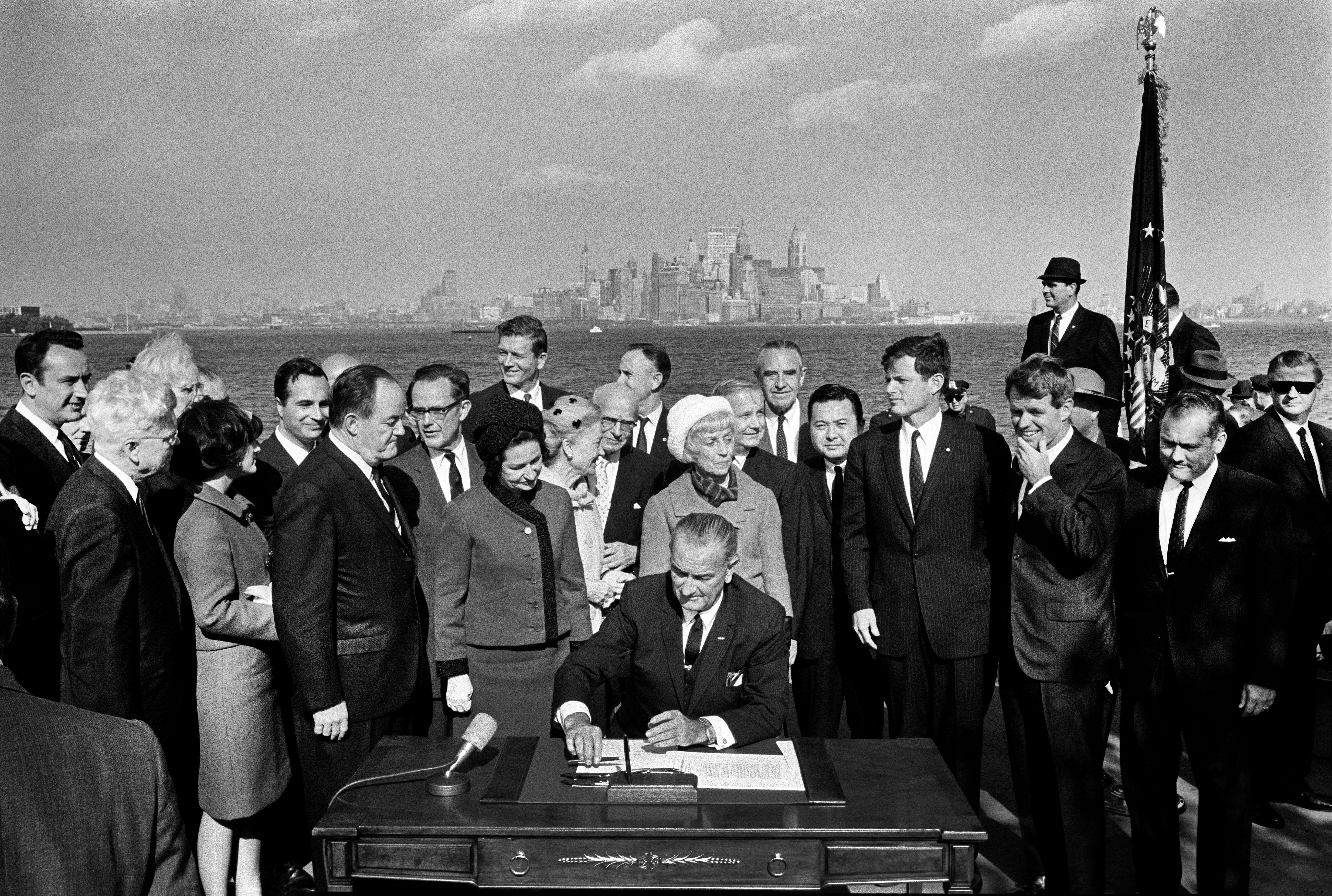
President Lyndon B. Johnson signs the Immigration and Nationality Act of 1965. (Photo by: GHI / Universal History Archive / Universal Images Group via Getty Images)

For a while now I’ve been wanting to write about a widespread misunderstanding about the history of American immigration policy. Fortunately, Donald Trump’s decision to respond to the blue wave by promoting Stephen Miller to chief of staff gives us a news hook, because he is a frequent purveyor of this misunderstanding.

This is from an April profile of Miller in the New York Times, and even though the authors quibble with Miller, they actually miss his biggest mistake:

Mr. Miller has blamed many of the country’s problems on a landmark 1965 law that paved the way for more Hispanic and Asian immigrants, a shift from primarily allowing in Europeans.

Despite decades of data showing that immigrants outperform native-born Americans on major indicators, including crime rates and use of welfare, Mr. Miller contends that those who entered after the 1965 law, as well as their descendants, have largely been unsuccessful.

“If you bring those societies into our country and then give them unlimited free welfare, what do we think’s going to happen?” he told Fox News in December. “We need a moratorium on immigration from third world countries until we can heal ourselves as a nation.”

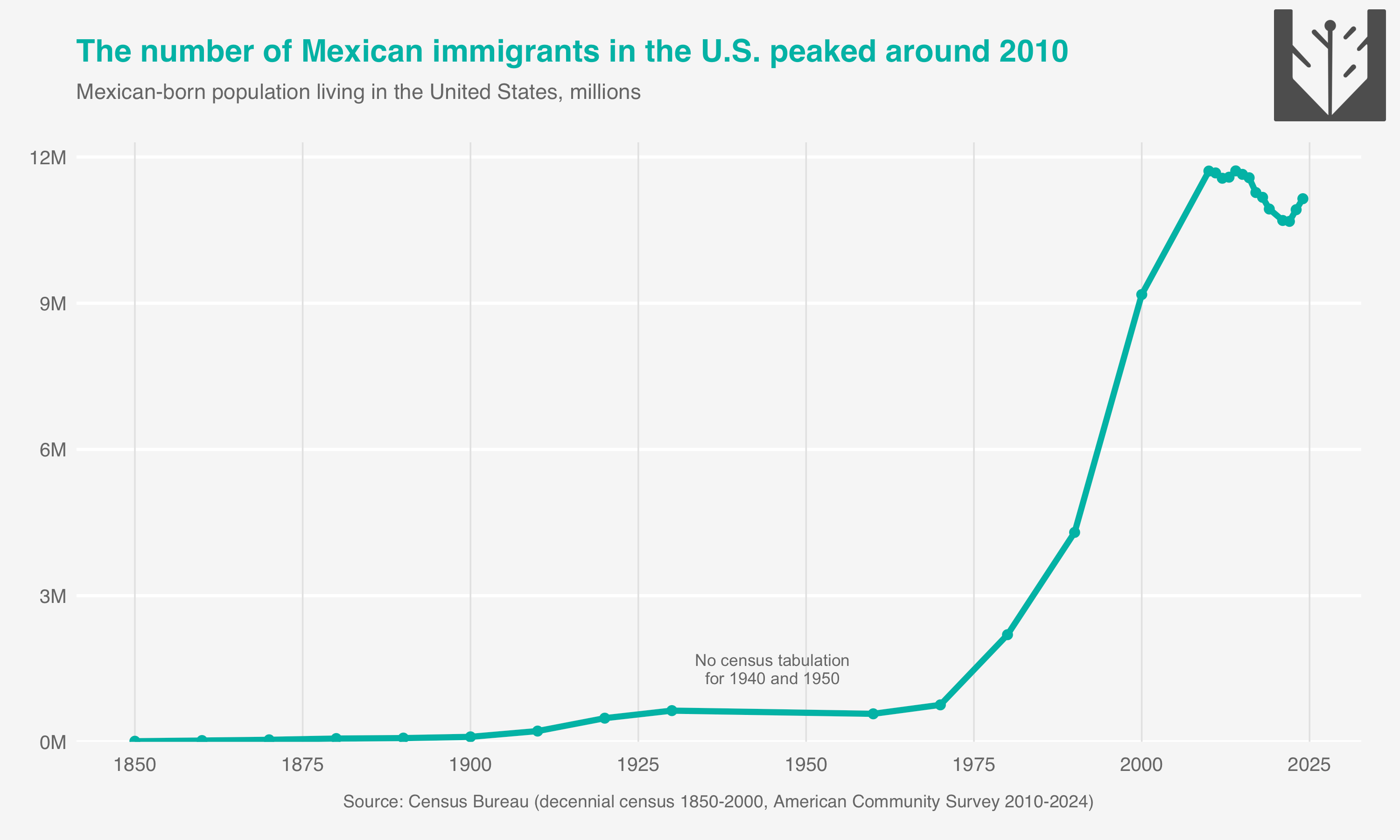
Here’s the issue: While it is true that the United States enacted a major change in immigration policy in 1965 and it is also true that Hispanic immigration to the United States increased significantly after 1965, it’s simply not the case that the 1965 law paved the way for more Hispanic immigrants. It’s actually the complete opposite — the 1965 law imposed quantitative restrictions on immigration from Latin America that didn’t exist previously.

It would probably be going too far to say that it’s a total coincidence that these things changed at around the same time, but the relationship is indirect and unrelated to the text of the immigration law.

What Hart-Celler did

The law at issue is the Immigration and Nationality Act of 1965, also known as the Hart-Celler Act after its main authors.

This law was a major reversal of immigration policy from the National Origins Formula adopted back in 1921. These 1921 immigration quotas were not adopted to keep out people from the “third world” as Miller would understand it. The point of the 1921 law was to prevent people from Southern and Eastern Europe — people like Miller’s ancestors or First Lady Melania Trump — from coming to the United States.

It also restricted immigration from Asia, though Asian immigration was already severely limited by laws such as the Chinese Exclusion Act of 1882 and the 1907 “Gentlemen’s Agreement” with the Japanese government to stop giving passports to U.S.-bound Japanese laborers. The Naturalization Act of 1870 made it impossible for immigrants from Asia to become American citizens while for the first time explicitly creating a process of naturalization for “aliens of African nativity and to persons of African descent.”

Which is just to say that this was all happening under a very different political paradigm than the contemporary immigration debate.

You often hear restrictionists express nostalgia for the midcentury immigration system. But they’re really just saying they liked the low level of immigration — or maybe that they approve of the broad principle of discriminating on the basis of nationality — not that we should replicate the specific details of the quota system. Nobody today thinks the United States should prefer immigrants from Western Europe over immigrants from Eastern Europe.

At any rate, the impetus for the Hart-Celler Act was to create a non-discriminatory immigration system in which your ability to get a visa would be based on individual-level criteria rather than nation of origin.

But in the case of Latin America and the Caribbean, that meant making policy more restrictive.

The old National Origins Formula didn’t apply any cap at all to migration from within the Western Hemisphere. Which isn’t to say the border was per se “open” — there were border controls and often intrusive sanitation procedures at the U.S.-Mexico border, along with literacy tests and other qualitative controls. Legally speaking, you needed a visa to work in the United States, and the ability to get those waxed and waned over time. During the Great Depression, there was a big push to repatriate Mexicans back south of the border, but then during World War II, the Bracero Program was started up to bring in more seasonal workers.

Hart-Celler neither intended to increase Latin American immigration nor had any provisions to increase Latin American immigration. In 1965, when the law passed, there were just under 150,000 legal immigrants admitted from the Western Hemisphere, and 37,000 of these were Canadians. The new system capped Western Hemisphere immigration at 120,000 per year, and the Bracero Program ended in 1964. So in theory, there should have been a modest cut in permanent immigration from Latin America as a whole and a large cut in temporary labor migration from Mexico specifically.

So what happened?

It’s kind of funny that immigration restrictionists forget this, but what happened was illegal immigration.

The Hart-Celler law created a more restrictive environment for legal migration, but it didn’t actually do anything about the fact that the U.S.-Mexico border is extremely long and sparsely populated in many places. Even during the Bracero years, there was a good amount of illegal agricultural and other casual labor happening, and with the legal temporary migration channel shut down, more people started coming illegally.

Scholars seem to disagree as to why the volume of illegal immigration was so much higher than the prior volume of legal immigration. But part of the issue is clearly just that Mexico had a huge baby boom and there were literally more people around who could migrate. The United States was also becoming richer, meaning plenty of opportunity for people willing to do unpleasant jobs like agricultural work.

Still, the really big surge in Mexican immigration to the United States took off quite a bit after the 1965 law’s passage, because it was basically unrelated to those policy changes.

Ironically, the 1996 Illegal Immigration Reform and Immigrant Responsibility Act, which was supposed to clamp down on illegal immigration, seems to have accelerated the growth of the Mexican-born population in the United States.

That’s because by making it substantially harder — but still doable — to cross the border, it shifted the balance of illegal workers toward “cross once and stay” rather than “go back and forth seasonally.” Eventually, the cratering of Mexican population growth plus ever-hardening border security plus the collapse of the American labor market in 2008 brought this to an end.

Then as the economy started to recover in 2014, you started to see a very different set of immigration problems largely driven by people (mostly not from Mexico) making asylum claims rather than trying to sneak past the Border Patrol.

Long story short, though, the transformation of American demographics driven by immigration from Mexico was not the result of the 1965 immigration bill or of any other deliberate shift in immigration policy.

The other large Hispanic populations in the United States (Puerto Ricans and Cubans) also don’t have anything to do with the 1965 bill. Puerto Ricans are American citizens who can move to the mainland as they wish. Meanwhile, until around 2016, the United States maintained a policy of welcoming basically anyone from Cuba as a refugee.

Real debate and real reforms

Who cares about all this history except pedants? Maybe nobody. But I always do hold out vague hope that a clearer understanding can create space for better policy, more compromises, and a happier outcome.

Donald Trump, for example, in his interview with Ross Douthat seemed to float the idea of an amnesty program for people who’ve been living and working illegally in the United States for a long time.

This is not the first time that Trump has seemed to embrace the logic of comprehensive immigration reform. Part of the power of Trumpian immigration politics is that he’s been happy to just lie and say that the typical person who immigrates to the United States illegally or tries to exploit loopholes in asylum laws is a criminal or a terrorist. Whenever he’s confronted with the reality that it’s mostly people just trying to make more money and that millions of them have been quietly working in restaurants or cleaning houses or doing casual construction labor, he kind of glitches out.

It’s not good to expend a large amount of resources on rounding these people up and kicking them out, and it drives political backlash to interior enforcement in general.

Obviously, though, Republicans aren’t going to flip and give Democrats what they want on this. The old concept was that a deal would include lots of measures on border security, but Republicans aren’t going to want that now, because they’ve already achieved what they wanted on border security through partisan bills. What I can imagine, though, are changes to real features of the Hart-Celler system.

One potential area for negotiation is that a very large fraction of America’s immigration visas are allocated on the basis of “family reunification” — i.e., you get in based on having relatives in the United States. Conservatives reasonably believe that immigration should be selective, aimed at bringing over people who are most likely to make large positive economic contributions to the United States. Cosmopolitans reasonably want to make room in the system for refugees and others with strong humanitarian claims. Family reunification is neither of these things and seems ripe for reform in favor of mostly skills-based immigration, spousal visas, and some number of refugees.

Another is that asylum law should be tightened on a permanent basis. But Trump hasn’t even tried to pass an immigration bill, so there’s been no discussion during his second term of what conservatives actually want out of immigration policy and what they might be willing to give up to get it.

But I think that starts with setting aside this paranoid and inaccurate view of immigration history where somebody decided in the mid-1960s to dramatically increase immigration from the “third world.” There was a ton of illegal immigration specifically from Mexico in the 1980s and 1990s for reasons that are basically unrelated to official acts of Congress. Excavating the political history of why the federal government was relatively slow to crack down on this could be interesting, but the crackdown really did happen, and over the past 10 years, immigrants have been coming from different countries through completely different channels.

Share

Read the whole story
mareino
6 days ago
reply
Washington, District of Columbia
Share this story
Delete

https://screenshotsofdespair.tumblr.com/post/833737937515692033

1 Share
Read the whole story
mareino
7 days ago
reply
Washington, District of Columbia
Share this story
Delete

The root of human degradation lies in the fact that two is a larger number than one.

1 Share

The root of human degradation lies in the fact that two is a larger number than one.

Read the whole story
mareino
7 days ago
reply
Washington, District of Columbia
Share this story
Delete

There Is No Place In A Functional Society For Elon Musk

jwz
2 Shares
There Is No Place In A Functional Society For Elon Musk

Somewhere amid all the Congressional hearings called for by all of this, though, someone simply must find time to break Elon Musk on the fucking wheel. The level of wealth he has attained would make him an existential threat to democracy even if the United States had reasonable campaign-finance laws, which it does not, and even if Musk were not, personally, an open and explicit enemy of pluralism, of the rule of law, and of racial and gender equality, which he is. As things stand, he is, in literal and fundamental terms, incompatible with a functional and functioning society. [...]

The silver lining in allowing such obscene wealth and power to concentrate themselves in one revolting addled herb, constitutionally incapable of winning the sincere esteem of any person less detestable than himself, is this: It is a problem with the exact same size, dimensions, and outline as Elon Musk himself. Yes, OK, sure: He is in turn a symptom of a much larger and more complex problem, that of capitalism itself. We will deal with that as we go. But Elon Musk's wealth and power can be broken, as straightforwardly as by breaking Elon Musk. The most direct path to doing durable good for American democracy, right now, is the one that leaves tire tracks across Elon Musk's stupid fucking face. [...]

Tell your congresspeople! You must break Elon Musk. Make him a scarecrow for the other members of his class. There will never be a better opportunity: People want blood, and virtually everyone in the world hates this scumbag. If Elon Musk has so much as a million dollars to spend on the 2028 election, the blue Congress will have airballed a layup.

Previously, previously, previously, previously, previously, previously, previously.

Read the whole story
mareino
14 days ago
reply
Washington, District of Columbia
satadru
15 days ago
reply
New York, NY
Share this story
Delete
Next Page of Stories