Mike Tomlin has been building a Minecraft city for more than 12 years. Drivers feel trapped, want more transportation options. Ideological plan from USDOT would weigh marriage, birth rates in funding decisions.
NFL coach designs dense city on the water: Former Pittsburgh Steelers head coach Mike Tomlin started playing Minecraft to bond with his children and has now spent more than 12 years building an intricate city. Tomlin started the city around a body of water with an eye on density. (Nora Princiotti | The Ringer)
Car dependence hurts everyone: 73% of drivers feel as though they aren’t able to cut down on their driving, and more than half say they want more transportation options. Of households with cars, the lowest-income ones spend 40% of their income on transportation. (Climate & Communities Institute)
Plan would tie birth, marriage rates to federal transit funding: More federal funding would go to transit corridors with higher birth and marriage rates under a proposal from the Federal Transit Administration. Senator Patty Murray (D-Washington) criticized the plan as dystopian. A policy like this would steer funding to wealthier, whiter communities that have more homeowners and higher shares of drivers. (Sam Ogozalek | Politico)
How apartment dwellers think about transportation: 20 interviews with Melbourne residents indicated that people’s accumulated experience with public transportation helps shape their attitudes toward it. Residents might choose to live close to transit, but experience with the system over time is more important to determing use than that one-time decision. (Transport Research Interdisciplinary Perspectives)
Cities invest in community safety agencies: Baltimore and Seattle are among the cities investing in public safety interventions that are separate from police departments. The idea is to have experts connect vulnerable residents to services before a crisis that prompts a law enforcement response. (Tahir Duckett | The New Republic)
Quote of the Week
“The societies that prevail are those that can construct infrastructures, train people, build institutions and reorganize production around new technologies. This is the painstaking work of decades, rather than the one-time boost that comes from inventing a new frontier technology.”
Simon Curtis and Ian Klaus in Noema Magazine discussing how the United States is falling behind on long-term thinking.
This week on the Talking Headways podcast, we’re joined by recent University of Southern California PhD graduate Wendy Zhou to discuss her dissertation, which focuses on dynamic accessibility. We talk about how static maps without a time-based dimension don’t tell the whole story on access and cover the idea of people-based accessibility.
What's with these AIs escaping and hacking people? That sounds scary.
Me:
You park your car at the top of a hill. You leave a note on the dashboard that says "please be good" and then you pull the parking brake. The car careens down the hill, smashes everything up, and you put out a press release saying "My car ignored my instructions! It hallucinated! It went rogue!" Your insurance company not only believes you, but invests a hundred million dollars in your company.
I saw the above request in a Facebook thread. I don't normally monitor Photoshop request sites, but I have enjoyed some responses I've seen in the past, including my post "When you ask the internet for assistance" in 2017, this "Photoshop battle" in 2018, and more recently "AI is the new Photoshop" earlier this year. So I was delighted and not surprised to see these responses to the above request:
There are dozens more at the Facebook source; cyberspace abounds in amazingly creative people.
Mayor Muriel Bowser’s administration is putting parking ahead of people, again. On September 24, the Office of Planning (OP) released a 188-pageRobert F. Kennedy Campus Master Plan draft. Others have rightly pointed out the plan’s shortcomings ontransit, and many neighbors are mad about specificamenities around the future stadium.
But most media coverage is missing that this plan is deliberately shortchanging housingin ways that undermine the project’s high-minded goals and hurt the District’s financial bottom line.
Parking, parking, and more parking
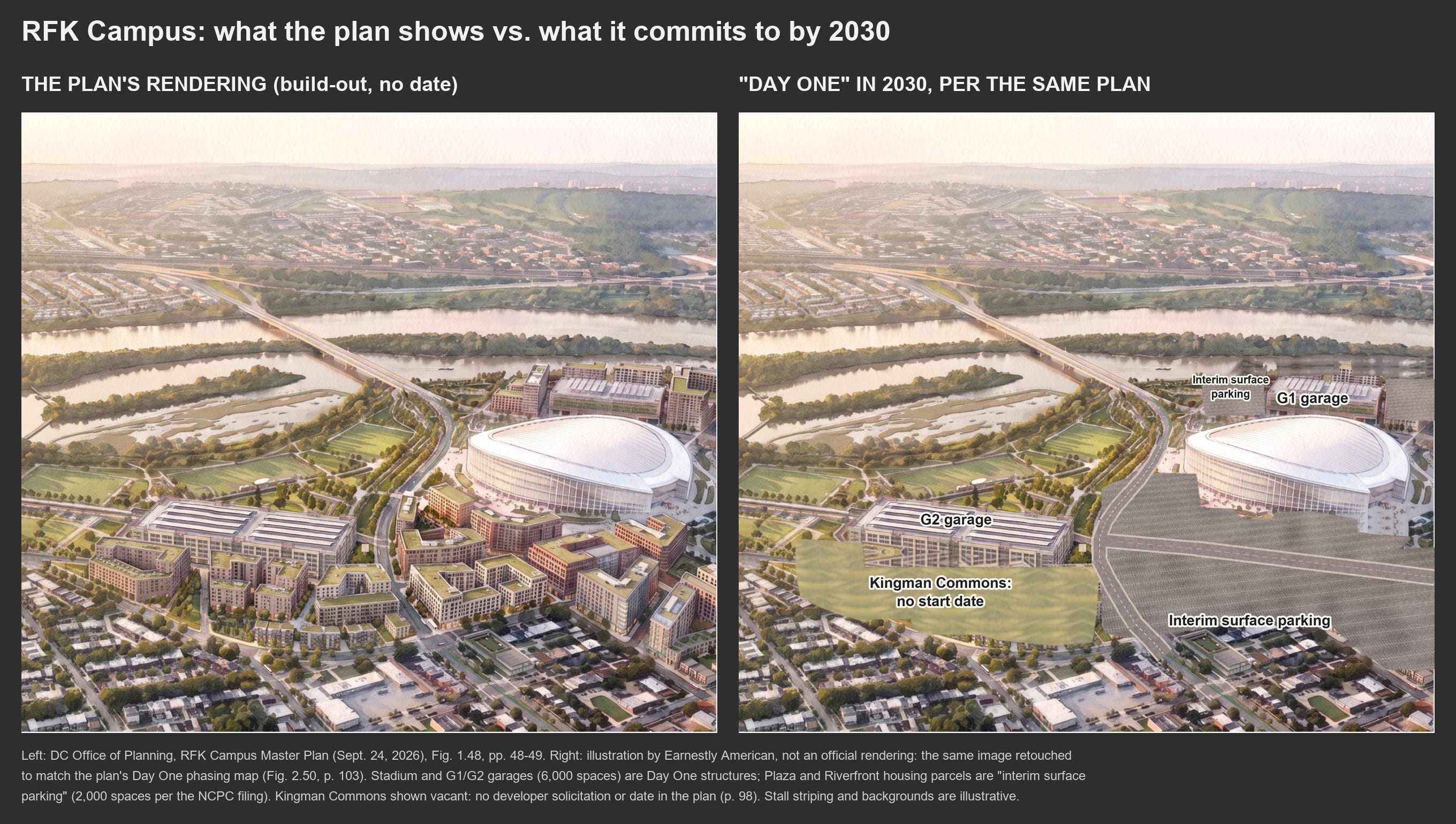
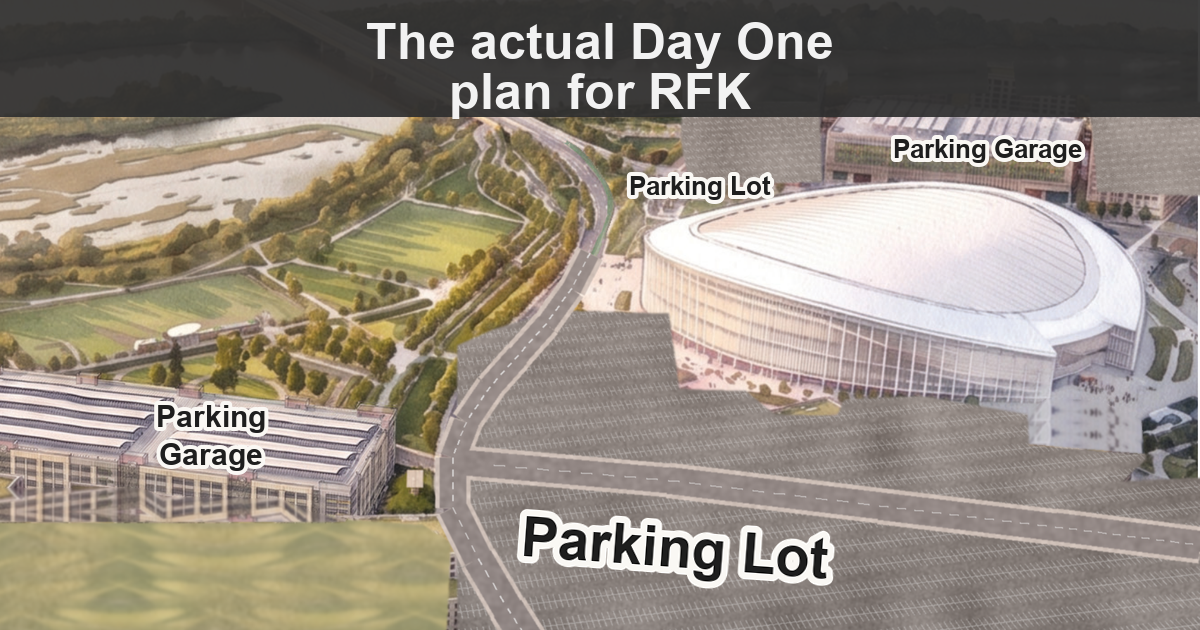
DC’s current plan is to build 6,000 parking spaces before we build a single home. Bowser’s vision for “Day One” in 2030 is that the vast majority of the “planned” residential areas are “interim surface parking” instead of housing. The plan has pretty visualizations of what the development will look like at some uncommitted point in the future, but the only commitment in the plan is for a ton of parking like this:
Left: Rendering from the RFK Campus Master Plan. Right: Illustration by the author to match the plan’s Day One phasing map.
The RFK plan is just the latest example of how DC’s planning process under our so-called “pro-growth” administration has prioritized everything but maximizing timely housing production.
The RFK deal explicitly exempted the stadium and parking garages from zoning to speed up construction, but didn’t extend the same relief to housing at the site.
The plan prioritizes parking spaces that sit vacant more than 300 days a year over housing for full-time residents.
The plan makes numerous trade-offs that prioritize aesthetics over maximizing housing on scarce waterfront property.
Delaying housing makes a bad fiscal deal even worse
The DC Council’seconomic analysis found that the planned housing and non-stadium commercial development around the stadium produces 76% of the project’s tax revenue and that maximizing housing instead of building a stadium would have led to more economic growth. While we’re stuck with a stadium, it still matters on the margin how much housing we get and how fast.
Each year of delay or shrinkage in the number of homes results in millions of dollars in foregone economic growth and tax revenue. But delay and shrinkage are exactly what is happening:
The plan quietly shifts the goalposts to “5,500 to 6,500” housing units, potentially losing up to 1,000 housing units.
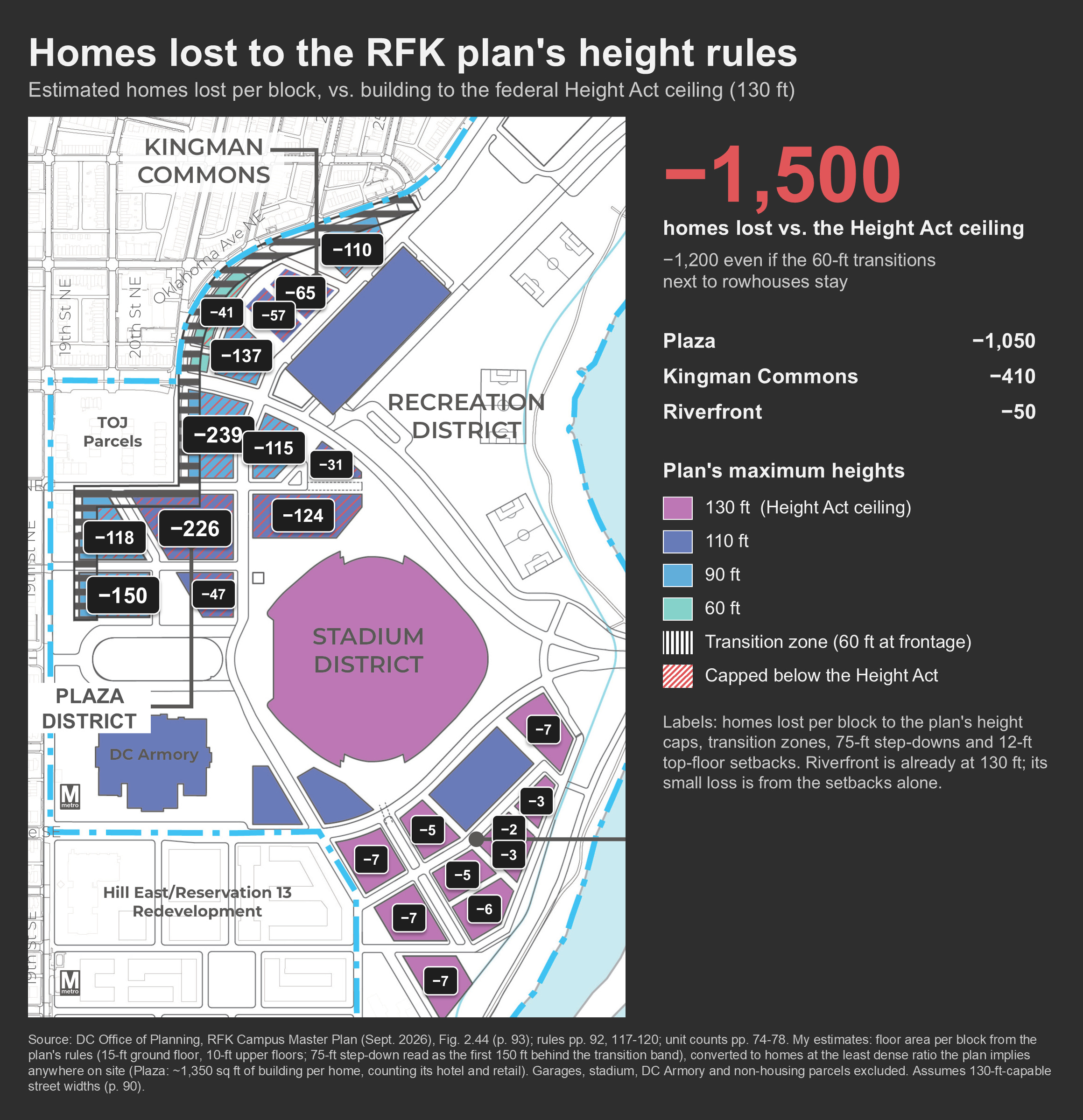
The plan caps the size of the residential buildings for aesthetic reasons, which costs us about 1,500 housing units vs. what the Height Act would allow.
Because the deal requires 30% of housing units to be income-restricted “affordable” housing, this scale of shrinkage would eliminate hundreds of dedicated affordable units.
Image on the left from the RFK Campus Master Plan, annotations by the author.
Self-imposed shortness
As much as we rightly gripe about the Congressionally-imposed Height Act harming DC, we often do more damage to ourselves through locally-imposed restrictions. The DC Office of Planning created these height and setback restrictions without any calculation of how this hurts the plan’s housing and economic impact.
The plan is very clear these restrictions are for aesthetic reasons (emphasis my own):
The height strategy for the RFK Campus organizes the tallest buildings along the perimeter of the stadium and along the river, with gradual reduction in height adjacent to the lower-scale surrounding neighborhoods.
Buildings should utilize a combination of design strategies to further break down the scale and reduce visual impact, including stepbacks, changes in plane, or changes in material.
Obviously some people really hate looking at tall buildings, especially next to their neighborhood. This came out in public input sessions that shaped the plan (emphasis my own):
Many commenters expressed excitement about the proposed building heights and mixed-use development program, emphasizing the importance of maximizing housing production. A similar number of commenters, mostly neighboring residents from Kingman Park and Hill East, expressed concern about building heights adjacent to existing low-rise residential neighborhoods and modern architecture that might feel out of character.
The Office of Planning congratulates itself for taking a “balanced approach” that ultimately removes about 1,500 homes from the site through these height and setback restrictions. Note that the scale of these self-imposed housing losses is in the same ballpark as how much housing we might lose from OP silently revising the goal from 6,500 to “5,500 to 6,500” housing units.
OP doesn’t acknowledge the costs of these aesthetics concessions or the delays from prioritizing parking before housing. If we’re serious about reigniting DC’s stalled economy, we have to be honest about these costs.
What do we stand to lose?
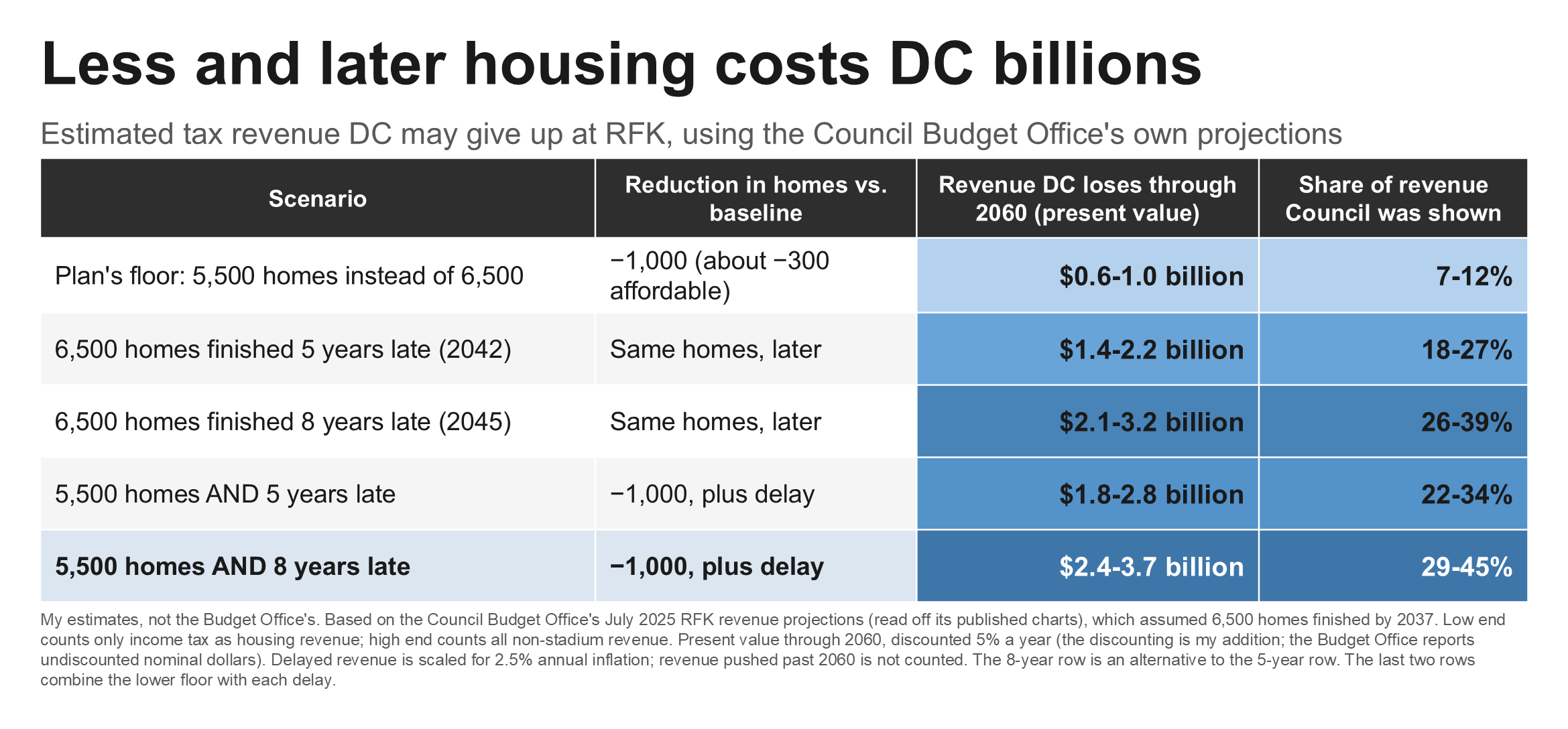
I used Claude to model the impacts of less and delayed housing at RFK under different scenarios. Even under conservative assumptions, we’re in danger of losing a huge share of the promised tax revenue because our economic planners are more concerned with parking and aesthetics:
My estimates, not the Budget Office’s. Based on the Council Budget Office’s July 2025 RFK revenue projections (read off its published charts), which assumed 6,500 homes finished by 2037. Low end counts only income tax as housing revenue; high end counts all non-stadium revenue. Present value through 2060, discounted 5% a year (the discounting is my addition; the Budget Office reports undiscounted nominal dollars). Delayed revenue is scaled for 2.5% annual inflation; revenue pushed past 2060 is not counted. The 8-year row is an alternative to the 5-year row. The last two rows combine the lower floor with each delay. Image by the author.
In an era of high interest rates, delays have enormous costs. Pushing out the promised tax revenues well into the 2040s dramatically reduces the benefit of this deal.
Conversely, a truly pro-growth mayor would be pushing to maximize housing on site, as fast as possible. Reversing these aesthetic restrictions on housing to add about 1,500 homes would provide approximately $0.9 billion to $1.4 billion in tax revenue and create an additional 450 affordable housing units.
As a geographically-tiny city, our limited land is an enormous constraint for growth. Every square foot is a scarce, precious resource and waterfront property like the RFK plot is even rarer. Our planners should be trying to maximize the economic potential of this site, not artificially restrict it.
More housing, less displacement
Increasing the housing supply would also do more to prevent displacement by offsetting the increased housing demand from the areas’ new amenities. The plan acknowledges that “These new homes can help reduce displacement pressures,” but then instead limits housing on the site while doing almost nothing to accelerate housing construction.
Felder pointed to a $60 million community reinvestment fund established in addition to the team’s contributions, designed specifically to focus on displacement prevention like rental assistance and property tax relief for long-term homeowners.
Previously, Felder voted against amendments to the RFK deal that would have done more to force the Commanders to actually build housing on schedule. Every politician that claims to care about displacement needs to be pushing the mayor and Commanders to build as much housing as they can, as fast as they can.
the DC Surveyor, the office that finalizes those lot divisions, read the older rules narrowly and stopped the developer’s application, even though the Office of Planning, DDOT, and other city agencies have signed off on the project. Urban Atlantic says it spent roughly six months looking for a workaround with city officials before concluding there wasn’t one.
This kind of delay actively undermines investment in DC and hurts job growth and tax revenue. We have an entire economic development infrastructure under the Deputy Mayor for Planning and Economic Development (DMPED) which is supposed to streamline growth but is too often asleep at the wheel for anything other than the mayor’s obsessions with sporting events.
I encourage everyone to readAxios’ interview with Bowser to truly appreciate how much her focus on sports has warped economic policy in DC:
Her legacy, as she sees it: “All professional sports teams will be in the District of Columbia by 2030.”
Sports have been part of Bowser’s economic development strategy since her first year as mayor in 2015, when she pitched them as a way to develop neighborhoods and counteract D.C.’s dependence on federal jobs.
That was before the pandemic fueled remote work, emptying downtown, and DOGE took a buzzsaw to the federal workforce.
What she’s saying: “It seems clairvoyant, right?”
It’s shocking that the mayor looks at DC’s economy losing over 80,000 jobs since the pandemic and wants to take a victory lap.
COVID and DOGE aren’t Bowser’s fault, but one would think that a leader with the gift of foresight could have done more to diversify DC’s economy. Notably, the RFK deal hasn’t created any permanent jobs so far, and the rest of her “All professional sports teams will be in the District of Columbia by 2030” “legacy” is just maintaining what we already have. And her administration nearly lost the Capitals and Wizards to Virginia!
Axios tries to give Bowser credit for helping keep the Wizards and Capitals in DC, but in reality it wasVirginia State Senator Louise Lucas who blocked the deal and forced Monumental Sports & Entertainment to renegotiate with DC.
The mayor ultimately didn’t lose the Capitals and Wizards, but that was because she was bailed out by Virginia Democrats, not any “clairvoyant” action. In the same interview, Bowser talks a good game of balancing sports with other priorities:
“It’s not, ‘Do you invest in sports, or do you invest in this other thing?’” she says. “You have to invest in both.”
But her RFK plan makes it clear what her priorities are. Parking and a football stadium get exempted from zoning and are ready for the “Day One” launch. Most of the promised housing will instead be “temporary” surface parking lots and the housing plan gets bled by a thousand cuts to satisfy aesthetic considerations.
We have the money for a football stadium and parking garages, but not for a desperately needed Metrorail station. Even the mayor’s fiscal priorities take a backseat to football. The RFK plan risks billions in future tax revenues by delaying and minimizing housing while the commitments to the Commanders are treated as sacrosanct.
What DC’s next mayor can do
Obviously our next mayor needs to do better. We’re in an economic, fiscal and housing crisis; and in response Democratic nominee Janeese Lewis George has promised to build72,000 new homes in five years. That will only happen if every level of government is seeking to maximize housing production throughout the city and using every tool we have to make it easier to build cheaper, faster and denser.
How our next mayor staffs these critical District agencies and works with the Council will determine if RFK and other smaller deals deliver the housing we desperately need. This post’s analysis shows how relatively minor staff decisions can quietly remove or add thousands of homes. Business as usual in our planning process doesn’t even bother estimating the economic and fiscal costs of slowing and shrinking housing; it instead treats delays and shrinkage as “free.”
These costs add up and would be treated as an outrage if anyone proposed them as a tax or fee, but we quietly accept them as just the “cost of doing business in DC” under our “pro business” mayor. The same culture of “No” in our planning agencies that produced this RFK plan hurts housing production across dozens of lower-profile deals, and everyday Washingtonians pay the price in higher housing costs. One of the reasons I supportGreater Greater Washington is that it’s often a lonely voice highlighting the impact of these decisions and trying to push housing policy in a better direction.
Democratic mayoral nominee Janeese Lewis George has a chance to be a wildly more “pro-growth” mayor than her predecessor. Often ourlocalpolitical class treats “hating Progressives and Socialists” as synonymous with “pro-growth” but the failures of the Bowser administration to reform our planning system and zoning show there’s plenty of low-hanging fruit for her successor. Fixing the technocratic nitty-gritty of development in DC is the crown lying in the gutter for a future mayor.
Disclaimer: I’m married to Ward 1 Councilmember Brianne Nadeau, who voted against the RFK deal and for most of the amendments discussed above that would have strengthened it. She was right. I also serve on the board of Greater Greater Washington. The views here are my own. I used Claude to help with research and graphics.
Top image: A mural at Northwest Stadium in Landover. Fighting for DC means putting people above parking. Image by All-Pro Reels licensed under Creative Commons.
Mayor Muriel Bowser’s administration is putting parking ahead of people, again. On September 24, the Office of Planning (OP) released a 188-page Robert F. Kennedy Campus Master Plan draft. Others have rightly pointed out the plan’s shortcomings on transit, and many neighbors are mad about specific amenities around the future stadium. But most media coverage is missing that this plan is deliberately shortchanging housing in ways that undermine the project’s high-minded goals and hurt the District’s financial bottom line.
Parking, parking, and more parking
DC’s current plan is to build 6,000 parking spaces before we build a single home. Mayor Bowser’s vision for “Day One” in 2030 is that the vast majority of the “planned” residential areas are “interim surface parking” instead of housing. The plan has pretty visualizations of what the development will look like at some uncommitted point in the future, but the only commitment in the plan is for a ton of parking like this:
This is just the latest example of how DC’s planning process under our so-called “pro-growth” administration has prioritized everything but maximizing timely housing production.
The RFK deal explicitly exempted the stadium and parking garages from zoning to speed up construction, but didn’t extend the same relief to housing at the site.
The plan prioritizes parking spaces that sit vacant more than 300 days a year over housing for full-time residents.
The plan makes numerous trade-offs that prioritize aesthetics over maximizing housing on scarce waterfront property.
Delaying housing makes a bad fiscal deal even worse
The DC Council’s economic analysis found that the housing and non-stadium commercial development around the stadium produces 76% of the project’s tax revenue and that maximizing housing instead of building a stadium would have led to more economic growth. While we’re stuck with a stadium, it still matters on the margin how much housing we get and how fast.
Each year of delay or shrinkage in the number of homes results in millions of dollars in foregone economic growth and tax revenue. But delay and shrinkage are exactly what is happening:
The plan quietly shifts the goalposts to “5,500 to 6,500” housing units, potentially losing up to 1,000 housing units.
The plan caps the size of the residential buildings for aesthetic reasons, which costs us about 1,500 housing units vs. what the Height Act would allow.
Because the deal requires 30% of housing units to be income-restricted “affordable” housing, this scale of shrinkage would eliminate hundreds of dedicated affordable units.
As much as we rightly gripe about the Congressionally-imposed Height Act harming DC, we often do more damage to ourselves through locally-imposed restrictions. The DC Office of Planning created these height and setback restrictions without any calculation of how this hurts the plan’s housing and economic impact.
The plan is very clear these restrictions are for aesthetic reasons (emphasis added):
The height strategy for the RFK Campus organizes the tallest buildings along the perimeter of the stadium and along the river, with gradual reduction in height adjacent to the lower-scale surrounding neighborhoods.
Buildings should utilize a combination of design strategies to further break down the scale and reduce visual impact, including stepbacks, changes in plane, or changes in material.
Obviously some people really hate looking at tall buildings, especially next to their neighborhood. This came out in public input sessions that shaped the plan:
Many commenters expressed excitement about the proposed building heights and mixed-use development program, emphasizing the importance of maximizing housing production. A similar number of commenters, mostly neighboring residents from Kingman Park and Hill East, expressed concern about building heights adjacent to existing low-rise residential neighborhoods and modern architecture that might feel out of character.
The Office of Planning congratulates itself for taking a “balanced approach” that ultimately removes about 1,500 homes from the site through these height and setback restrictions. Note that the scale of these self-imposed housing losses is in the same ballpark as how much housing we might lose from OP silently revising the goal from 6,500 to “5,500 to 6,500” housing units.
OP doesn’t acknowledge the costs of these aesthetics concessions or the delays from prioritizing parking before housing. If we’re serious about reigniting DC’s stalled economy, we have to be honest about these costs.
What do we stand to lose?
I used Claude to model the impacts of less and delayed housing at RFK under different scenarios. Even under conservative assumptions, we’re in danger of losing a huge share of the promised tax revenue because our economic planners are more concerned with parking and aesthetics:
In an era of high interest rates, delays have enormous costs. Pushing out the promised tax revenues well into the 2040s dramatically reduces the benefit of this deal.
Conversely, a truly pro-growth mayor would be pushing to maximize housing on site, as fast as possible. Reversing these aesthetic restrictions on housing to add about 1,500 homes would provide approximately $0.9 billion to $1.4 billion in tax revenue and create an additional 450 affordable housing units.
As a geographically-tiny city, our limited land is an enormous constraint for growth. Every square foot is a scarce, precious resource and waterfront property like the RFK plot is even rarer. Our planners should be trying to maximize the economic potential of this site, not artificially restrict it.
More housing, less displacement
Increasing the housing supply would also do more to prevent displacement by offsetting the increased housing demand from the areas’ new amenities. The plan acknowledges that “These new homes can help reduce displacement pressures,” but then instead limits housing on the site while doing almost nothing to accelerate housing construction.
Felder pointed to a $60 million community reinvestment fund established in addition to the team’s contributions, designed specifically to focus on displacement prevention like rental assistance and property tax relief for long-term homeowners.
Previously, CM Felder voted against amendments to the RFK deal that would have done more to force the Commanders to actually build housing on schedule. Every politician that claims to care about displacement needs to be pushing the mayor and Commanders to build as much housing as they can, as fast as they can.
the DC Surveyor, the office that finalizes those lot divisions, read the older rules narrowly and stopped the developer's application, even though the Office of Planning, DDOT, and other city agencies have signed off on the project. Urban Atlantic says it spent roughly six months looking for a workaround with city officials before concluding there wasn't one.
This kind of delay actively undermines investment in DC and hurts job growth and tax revenue. We have an entire economic development infrastructure under the Deputy Mayor for Planning and Economic Development (DMPED) which is supposed to streamline growth but is too often asleep at the wheel for anything other than the mayor’s obsessions with sporting events.
I encourage everyone to read Axios’ interview with Mayor Bowser to truly appreciate how much her focus on sports has warped economic policy in DC:
Her legacy, as she sees it: "All professional sports teams will be in the District of Columbia by 2030."
Sports have been part of Bowser’s economic development strategy since her first year as mayor in 2015, when she pitched them as a way to develop neighborhoods and counteract D.C.’s dependence on federal jobs.
That was before the pandemic fueled remote work, emptying downtown, and DOGE took a buzzsaw to the federal workforce.
What she’s saying: “It seems clairvoyant, right?”
It’s shocking that the Mayor looks at DC’s economy losing over 80,000 jobs since the pandemic and wants to take a victory lap.
COVID and DOGE aren’t Mayor Bowser’s fault, but one would think that a leader with the gift of foresight could have done more to diversify DC’s economy. Notably, the RFK deal hasn’t created any permanent jobs so far, and the rest of her “All professional sports teams will be in the District of Columbia by 2030” “legacy” is just maintaining what we already have. And her administration nearly lost the Capitals and Wizards to Virginia!
Axios tries to give Mayor Bowser credit for helping keep the Wizards and Capitals in DC, but in reality it was Virginia State Senator Louise Lucas who blocked the deal and forced Monumental Sports & Entertainment to renegotiate with DC.
The mayor ultimately didn’t lose the Capitals and Wizards, but that was because she was bailed out by Virginia Democrats, not any “clairvoyant” action. In the same interview, Mayor Bowser talks a good game of balancing sports with other priorities:
“It’s not, ‘Do you invest in sports, or do you invest in this other thing?’” she says. “You have to invest in both.”
But her RFK plan makes it clear what her priorities are. Parking and a football stadium get exempted from zoning and are ready for the “Day One” launch. Most of the promised housing will instead be “temporary” surface parking lots and the housing plan gets bled by a thousand cuts to satisfy aesthetic considerations.
We have the money for a football stadium and parking garages, but not for a desperately needed Metrorail station. Even the mayor’s fiscal priorities take a backseat to football. The RFK plan risks billions in future tax revenues by delaying and minimizing housing while the commitments to the Commanders are treated as sacrosanct.
What DC’s next mayor can do
Obviously our next mayor needs to do better. We’re in an economic, fiscal and housing crisis; and in response Democratic nominee Janeese Lewis George has promised to build 72,000 new homes in five years. That will only happen if every level of government is seeking to maximize housing production throughout the city and using every tool we have to make it easier to build cheaper, faster and denser.
How our next mayor staffs these critical District agencies and works with the Council will determine if RFK and other smaller deals deliver the housing we desperately need. This post’s analysis shows how relatively minor staff decisions can quietly remove or add thousands of homes. Business as usual in our planning process doesn’t even bother estimating the economic and fiscal costs of slowing and shrinking housing; it instead treats delays and shrinkage as “free.”
These costs add up and would be treated as an outrage if anyone proposed them as a tax or fee, but we quietly accept them as just the “cost of doing business in DC” under our “pro business” mayor. The same culture of “No” in our planning agencies that produced this RFK plan hurts housing production across dozens of lower-profile deals, and everyday Washingtonians pay the price in higher housing costs. One of the reasons I support Greater Greater Washington is that it’s often a lonely voice highlighting the impact of these decisions and trying to push housing policy in a better direction.
Democratic mayoral nominee Janeese Lewis George has a chance to be a wildly more “pro-growth” mayor than her predecessor. Often our localpolitical class treats “hating Progressives and Socialists” as synonymous with “pro-growth” but the failures of the Bowser administration to reform our planning system and zoning show there’s plenty of low-hanging fruit for her successor. Fixing the technocratic nitty-gritty of development in DC is the crown lying in the gutter for a future mayor.
Disclaimer: I'm married to Ward 1 Councilmember Brianne Nadeau, who voted against the RFK deal and for most of the amendments discussed above that would have strengthened it. She was right. I also serve on the board of Greater Greater Washington. The views here are my own. I used Claude to help with research and graphics.
 Log in


 reply
reply